- ABB Genix™ Industrial IoT and AI Suite expands its capabilities through the integration of NVIDIA Omniverse libraries, delivering physically accurate 3D industrial digital twins
- Uses ABB’s industrial AI and digital twin capabilities together with Microsoft Azure and Microsoft Foundry to provide scalable, secure, enterprise-grade deployment
- Enhances operational awareness by offering rich spatial context for asset health, anomaly detection, and overall system performance
- Establishes a foundation for simulation-driven and AI-enabled operations, supporting the industry’s transition toward increasingly autonomous operations
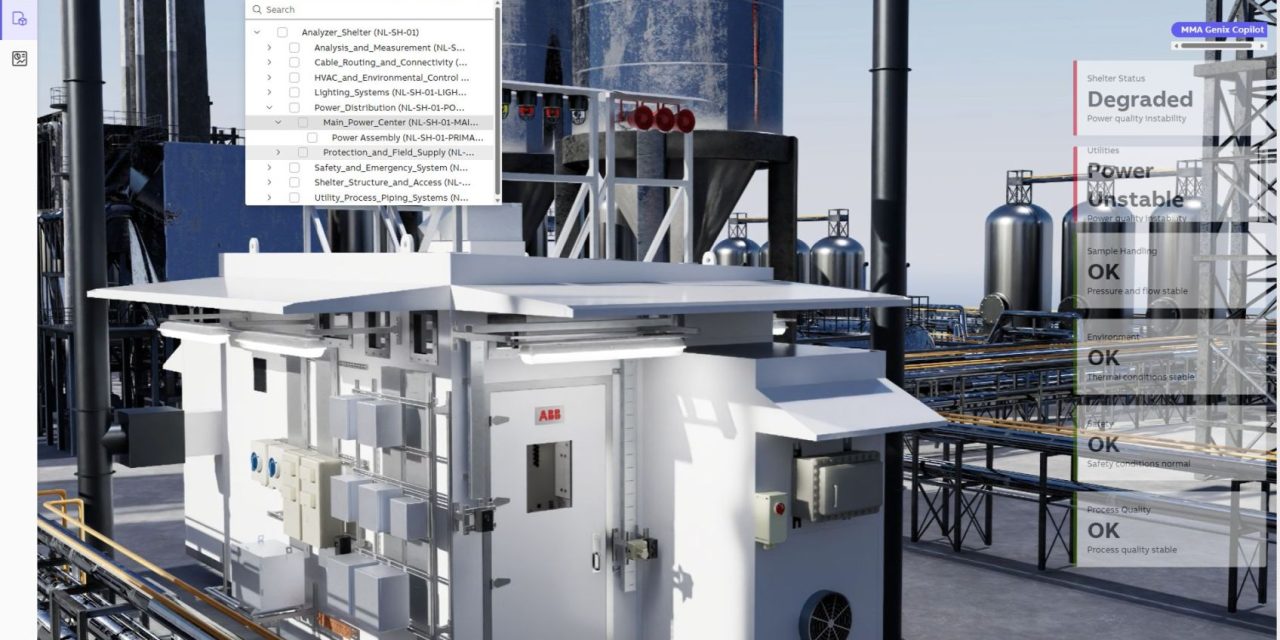
Today at Hannover Messe 2026, ABB announced an integration of its ABB Genix™ Industrial IoT and AI Suite with NVIDIA Omniverse and Microsoft Azure. This integration advances ABB Genix beyond traditional digital twins by delivering immersive, multi-dimensional operational insight. The collaboration strengthens ABB’s digital twin capabilities by combining industrial AI, high-fidelity 3D environments and cloud-scale computing, helping operators better understand system health, detect anomalies and make more informed decisions.
“Our customers are looking for more effective ways to better understand and optimize increasingly complex industrial operations. By combining AI-powered real-time industrial insights with the immersive capabilities of NVIDIA Omniverse, ABB Genix brings the convergence of real and simulated operations through context-rich photorealistic digital twins, helping organizations operate leaner and cleaner,” said Rajesh Ramachandran, Global Chief Digital Officer, Automation, ABB.
Building on ABB Genix’s established digital twin foundation, the integration protects customers’ existing investments while introducing new capabilities seamlessly into ongoing operations. The integration of NVIDIA Omniverse libraries enables operators to take advantage of immersive, high-fidelity 3D simulation environments. The combination with Microsoft Azure’s scalable cloud and AI services, improves situational awareness by making complex industrial systems easier to understand and navigate
ABB Genix converts asset health metrics, operational performance and operational data into a spatial, navigable context, enabling operators to see what is happening and where. This accelerates root-cause analysis, shortens response times and establishes a strong foundation for AI-driven insights and intelligent automation across operations.
The solution streamlines operator workflows by enabling intuitive drill-down from fleet-level insights to individual sites, systems and assets. In safety-critical scenarios, such as gas leaks, immersive visualization provides clear visual impact analysis, helping operators understand proximity and potential impact to support faster and more confident responses.
“Industrial operations are at an inflection point – the complexity of modern facilities demands more than dashboards and data; operators need spatial intelligence to act with speed and confidence,” said Vikram Natarajan, General Manager for Omniverse at NVIDIA. “By integrating NVIDIA Omniverse libraries into ABB Genix and deploying at scale on Microsoft Azure, ABB is delivering immersive, physically accurate digital twin environments that transform how operators monitor, analyze and respond across their facilities – accelerating the industry’s journey toward autonomous operations.”
“Using Microsoft Azure and Microsoft Foundry, ABB Genix is bringing cloud-scale AI, data and immersive environments to industrial customers – transforming how they monitor, simulate and optimize operational performance,” said Dayan Rodriguez, Corporate Vice President, Manufacturing and Mobility, Microsoft.”
By combining real-time operational data with immersive visualization and simulation capabilities, ABB Genix is creating an environment where real and simulated operations can converge. This lays the foundation for future physical AI and simulation-driven optimization, helping organizations improve operational resilience and finally accelerating the transition towards more autonomous operations.