Craig McDonnell, Managing Director, Business Line Industries, ABB Robotics, talks to Michelle Lea about how the company’s vision for Autonomous Versatile Robots (AVR) will open up new possibilities in logistics and warehouse automation

Without doubt, the big news story of 2025 was the burgeoning use of AI in industrial settings. Always keen to stay at the forefront of innovation, ABB Robotics is redefining automation in logistics and warehousing with its Autonomous Versatile Robot (AVR™) technology, which combines robotics, AI, and autonomous mobility. The aim is to create adaptive, intelligent, and scalable solutions that can adapt, reconfigure, and optimise autonomously. All features that are crucial due to the dynamic nature of logistics applications.
So, what are the key drivers for robotic automation in logistics? Craig McDonnell outlines four key factors:
Labour shortages and rising costs
The first challenge is around labour shortages. With fewer people wanting to work in warehousing jobs, it can be difficult to ensure that there are sufficient workers to process and handle orders, especially during periods such as seasonal peaks where demand can vary significantly.
E-commerce and faster fulfilment
With e-commerce shoppers conditioned to expect next or even same day delivery, labour availability also has a big impact on keeping orders flowing and maintaining customer satisfaction.
Sustainability pressures
Sustainability is another factor. Large warehouses take up a lot of space and consume a lot of energy, so operators are working with very slim margins. Productivity and efficiency gains can make a real difference to making operations more sustainable.
Digital readiness
The fourth key driver that can address the issues above is digital readiness and the use of AI in automation and robotics. The integration of AI, IoT, and data analytics has made robotics more flexible, modular, and ROI-positive. These technologies simplify deployment, provide real-time operational visibility, and allow predictive adjustments, accelerating the pace of adoption across logistics networks.
McDonnell illustrates the advantages of AI enhanced robotic technology in a warehouse scenario where a diverse range of products need to be sorted, picked and handled: “A classic example would be a warehouse handling clothing items. The retailer may have to deal with boxes full of different sized bags, proving a challenge for robots without any in-built intelligence. Using AI models to identify and characterise an object offers a huge advantage.”
ABB’s 2025 investment in LandingAI has enabled the integration of LandingLens, a generative AI, no-code vision platform, into ABB Robotics’ own software suite. For users, benefits include an 80% reduction in the time needed for training and deployment of vision systems. When combined with ABB’s RobotStudio simulation environment and OmniCore controller architecture, this integration enables robots to better handle variability in SKU types, packaging, layout changes, and seasonal peaks across tasks such as picking, depalletizing, induction, sorting, and inspection.
McDonnell said: “Using LandingLens has enabled us to develop solutions that can be scaled and adapted to meet changing requirements. The technology can identify and characterise objects quickly and accurately, making it possible to add new items or even repurpose whole lines to handle completely new products without the need for reprogramming, saving both time and disruption.”
It is this scalability, flexibility and usability which means the systems can operate in a plethora of applications, from picking parcels, picking bolts out of a bin, or manipulating clothing, for example. McDonnell cites another application, again in the clothing industry, where robotic systems may previously have found it difficult to switch from handling summer to winter clothing. Summer T-shirts and swimming costumes need to be handled in a different way to winter coats and heavy jackets and would have previously required different equipment.
He said: “Previously, introducing new clothing items meant either retraining the robots or having another set of equipment to handle these hugely varying subsystems. With our new architectures, together with AI-assisted learning, the same system can be retrained to handle summer clothing and winter clothing.”
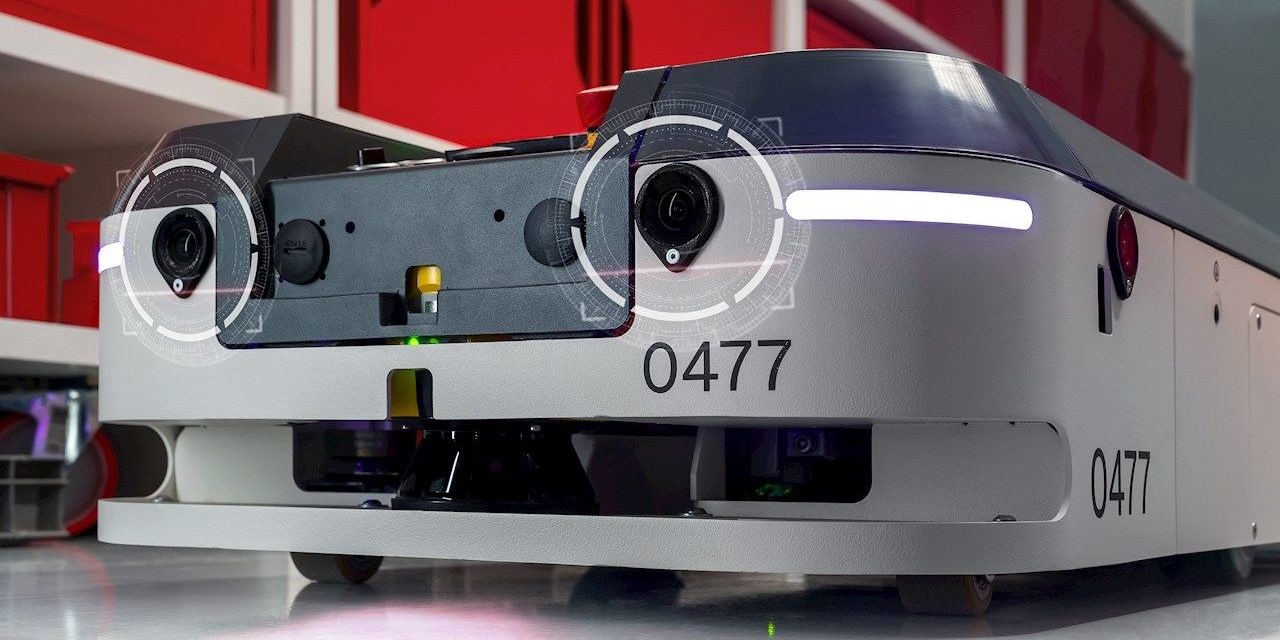
The way in which these robots perceive their environment is crucial to their efficient operation. ABB acquired Sevensense in 2024 and has integrated their vision capability into its range of Autonomous Mobile Robots (AMRs). Vision, together with other advances including AI and enhanced dexterity, are effectively equipping robots with “eyes, hands, brains and mobility”, mirroring the versatility of human workers whilst offering enhanced levels of endurance, precision and adaptability.
Technologies such as visual simultaneous localisation and mapping (VSLAM) can be used to navigate warehouses, identify obstacles, and optimise travel routes without manual intervention. According to McDonnell: “Mobile robotics and AMR accuracy is down to +/-5mm now, so the robot doesn’t get lost or stranded in the corner of the warehouse. They also know how to react to a person versus a pallet; once this has been optimised, you can improve availability.”
Opening up new opportunities through enhanced autonomy and versatility
ABB Robotics has described Autonomous Versatile Robotics as writing the next chapter in automation. McDonnell says the company is well-placed to be part of this evolution, with a range that encompasses collaborative robots designed to work in tandem with people, to industrial robots designed for speed and productivity, with the next step being intelligent, mobile robots.
Through AVR, ABB Robotics is advancing a new generation of robots capable of perceiving their surroundings through AI vision, responding to spoken instructions, and re-planning tasks autonomously. Six core capabilities underpin ABB’s vision for Autonomous Versatile Robotics, combining attributes including: advanced AI vision, precision, speed, dexterity and mobility, for heightened real-world productivity and flexibility.
ABB Robotics’ development of AI enhanced robotics is set to advance even further with the divestment of the division from the wider group to SoftBank Group, a Japanese multinational technology conglomerate and investment holding company.
Once the deal closes, it is anticipated that the acquisition will accelerate SoftBank’s “Physical AI” vision by combining ABB’s industrial robotics AI-driven software, hardware, engineering expertise, and global customer base with SoftBank’s broader portfolio of AI and robotics investments, as part of its long-term strategy to develop intelligent autonomous systems.
And to address the potential concerns that intelligent robots such as AVRs will displace jobs, McDonnell adds: “The future of logistics isn’t about replacing people. It’s about empowering them with automation that learns, adapts, and performs safely in the real world, freeing them to be more productive in higher-value areas.”
As we head into 2026, ABB Robotics looks set to lead the transformation of warehousing from static automation toward intelligent, autonomous logistics systems.