 In the battle against global warming the demand for cars which use less fuel and emit less CO2 is increasing and the potential for cost-saving is firmly in focus. One approach – the reduction of vehicle weight – is being researched by the German Institute for Manufacturing Automation and Production Systems (FAPS), which uses technology from screwdriving and automation specialist, Deprag Schulz.
Today the most popular accessories in a new car are the electronic devices. However it is these vehicle instruments which drive up the cost and weight of a vehicle. Weight, because the conventional wiring harnesses have increased so much in volume, and costs because automatic alignment and assembly of wiring harnesses based on existing assembly and connecting technologies is almost impossible.
Installing flexible flat conductor cable instead of standard wiring harnesses could be the answer. FAPS scientists have based research on this idea and also the automated handling and assembly of flexible flat cables. Their research has resulted in the development of a system prototype.
The FAPS research equipment enables robot-guided assembly and routing of multi-core flat cables onto a three dimensional module (e.g. a vehicle door panel) and assembly by means of hot-melt adhesive coating or laser welding. Central to the research is the means of electrical connection between the cable and functional components. Because the cables are only accessible from one side after they have been positioned, it was necessary to develop a new connection technology. The equipment had to be automated and include the additional step of penetrating the wire insulation. The patent pending ‘Direct Contact Spring Clip’ is the result of this project.
The feasibility of the Direct Contact Spring Clip has been demonstrated and evaluated on various assembly cells at the FAPS Institute. Among other things the automation of flat cable routing and connection as well as completely automated assembly of vehicle modules which contain flat cable components, have been tested.
As an example of the Direct Contact Spring Clip to flat cable assembly, one of the production cells employs two robots. In this case a loudspeaker is assembled to a vehicle door panel. Two linear robots are positioned sharing a common working area. In order to extend the working range of the robotic actuators, the work-piece/ assembly is mounted to an automated hexapod which allows additional positioning movements.
The gripper units of the robotic assembly cell have access to various tools. A sophisticated screw-driving system with screw feeding as well as a special Direct Contact Spring Clip gripper is used to connect the electrics of the loudspeaker with the flat cable to be mounted into the door panel.
The gripper was specifically developed for this task but, the team has relied on the screwdriving spindles, feeding systems and screwdriving controller technology from the specialists in screwdriving and automation, Deprag Schulz. The main component of the screwdriving system is a Deprag programmable screwdriver Minimate-E 320E27-0042. Project leader Markus Michl says: “Due to its small size and low weight this device proved to be the best suited screwdriving-spindle for the robot end-effector”.
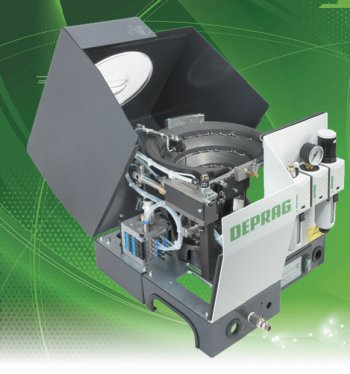
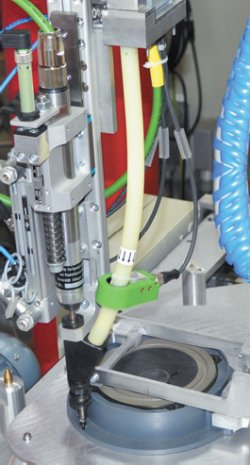 In order to automatically feed the screws required for the application, to the Minimate-E EC screwdriver, FAPS used a screwdriving system available from Deprag’s standard programme. Based on vibratory feeding technology, the screw feeding system is distinguished by its highly reliable feeding performance. It consists of a vibrator drive, a single spiral vibratory feed bowl and a screw separator. The screws are automatically fed through a feed hose before every screw assembly cycle. The screw is blow fed to the mouthpiece and nosepiece and accurately positioned ready for assembly. The robot positions the combination of screwdriver, mouthpiece and nosepiece over the screw location. With the help of a linear bearing slide the screwdriver moves downwards. The bit descends through the mouthpiece and nosepiece onto the head of the screw. After the start signal from the main controller the screw is tightened.
The screw is assembled in 1.3 seconds and is monitored and controlled by the Deprag screwdriver controller AST10, integrated with the central control system of the assembly cell.
Michl chose the Deprag AST10 as the screwdriving controller for this project because of its ease of integration into the control-system. The central controller component of the prototype FAPS assembly system is a PC, which is connected via several interfaces to the individual controllers such as the AST10 and which can be controlled by the PC. Connection is guaranteed between the central computer and both industrial robot machine controllers via the Ethernet, over which the data packages with guidance instructions in XML format can be set externally.
In order to make this as simple as possible for the user, elementary functions such as robot or Hexapod actions, the feeding of screws or the design of screwdriving programmes are integrated into a sequence controller in the object oriented script language Python. In this way the operator’s task is simply to specify the working instructions to the device in a preset data format and so the cables in the door module are assembled via a completely automated process.