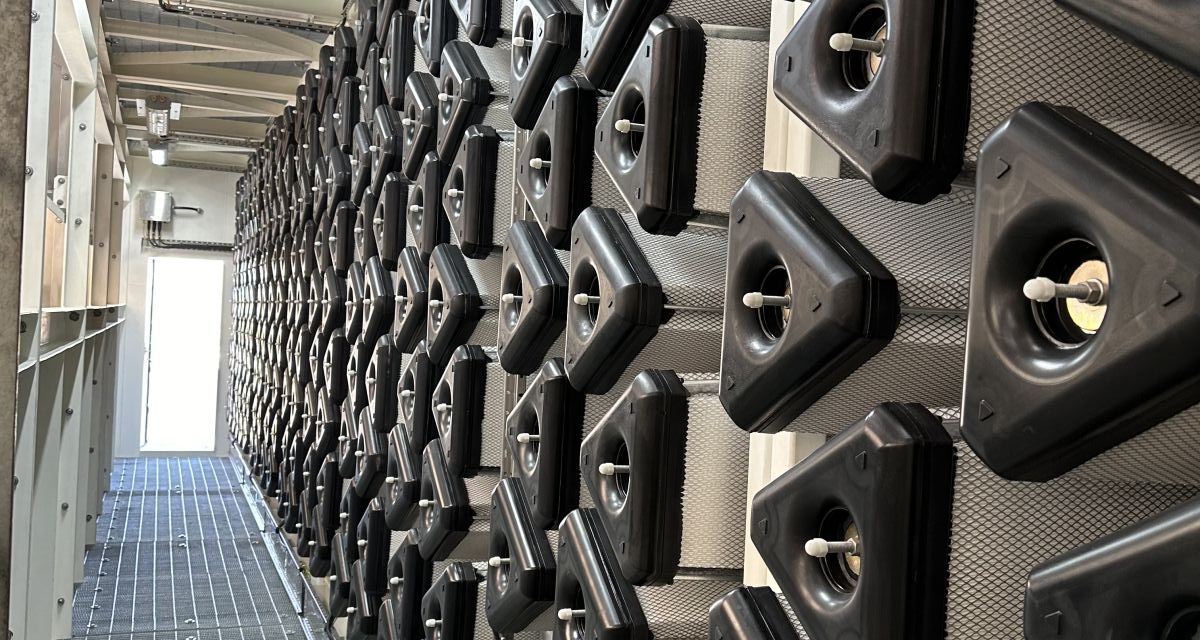
Automating production of its Tri-Dust Plus filter system, global filtration leaders Parker Hannifin are demonstrating the environmental benefits of advanced manufacturing extend to the next generation of filters too.

By Timothy Adeniyi Ajayi, Business Unit Director, Altair Business Unit, Filtration and Energy Solutions Division, Parker Filtration Group
Automated manufacturing is helping to accelerate product development and their subsequent delivery but is also delivering multiple environmental and economic benefits along the way. Investing in a fully automated production line for its newly released Tri-Dust Plus filter, Parker Hannifin is demonstrating these key advantages that support automation can bring.
Automation of manufacturing improves productivity at the plant as well as improving consistent quality assurance of the product during the manufacturing process and thus high quality when it is delivered to the end customer. In the case of the Tri-Dust Plus filter, robotic cells manage most of the filter assembly and handling, for example dispensing precise quantities of materials like polyurethane (PU) which reduces waste and means lower volumes of volatile components are released into the environment.
In addition, the automated system is capable of building multiple filters simultaneously while dramatically reducing the number of operators required. This has several impacts, for example a reduced number of operators lowers the environmental overhead associated with workers using consumables and PPE equipment like gloves, face masks, glasses, and wipes.
Automation not only cuts dependence on manual labour for repetitive tasks where errors can occur, the fully automated line can operate up to 24 hours per day, reducing energy wasted when the line is idle in a heated factory before the next shift starts resulting in a higher throughput with less time and energy consumed per unit manufactured.
The automated line also supports improved product design with a reduced part count in filters. This saves time during manufacturing as well as shipping these components.
Increased accuracy of application of materials and increased dimensional accuracy which results in reduced defects and a lower scrap rate. In addition, the automated system with its improved quality, cuts the time and energy that must be spent on product inspection and quality control. This also reduces time and energy on reworking and remanufacturing products.
The robot cells are optimally placed meaning reducing takt time and required floor space saving on the cost of workspace and the environmental impact of maintaining the workspace including direct energy usage for heating and lighting. Overall, the fully automated line uses fewer hours to produce the Tri-Dust Plus filter and thus offers a significant gain in productivity.
Aside from the clear economic benefits associated with the automated manufacturing process, quantifiable CO2e savings also result from the line. For example, the higher availability and quicker, higher density production line reduce the need for factory utilities like lighting, heating and floorspace and minimises the material, consumables and parts usage per unit. The reduced scrap rate and C02e associated with errors also have a carbon footprint as does other human interface requirements such as vending machines, seating and so on.
Beyond the direct benefits during the manufacturing process, the automated line also delivers advantages in the use of the Tri-Dust Plus product.
Achieving optimum performance
The aim of the filtration system is to maintain the optimum performance of the gas turbine in service. One of the key environmental benefits of theTri-Dust Plus design comes from its role in maintaining a more efficient gas turbine which therefore produces lower specific emissions per MWh generated. The filter ensures only filtered air enters the turbine preventing the ingress of particles, water, salt and other contaminants that can affect the aerodynamic efficiency of the compressor section of a gas turbine. Contamination that enters a gas turbine can also cause corrosion and potentially costly failure. However, the filtration system must achieve this while keeping the pressure drop to a minimum to keep the turbine operating as efficiently as possible.
The efficiency of the Tri-Dust Plus filter design enables these characteristics to be achieved while using a smaller, more compact filter house. This smaller footprint uses around 30% less materials for its construction, again representing significant environmental benefits by minimising the use of CO2e-rich materials like steel and concrete. The compact footprint also supports upgrading a retrofitting of gas turbines at existing sites which are challenging and often space constrained. This also potentially represents an environmental benefit by enabling the use of more modern, and therefore more efficient, advanced gas turbines.
Furthermore, the Tri-Dust Plus filter design has been optimised for the quantity of filter media used which is approximately half that used in conventional filters. As with the enclosure footprint, this is a significant reduction is the resources associated with the filter media.
In addition, by using the latest design tools the Tri-Dust Plus features optimisation of the filter self-cleaning function. This results in the need for fewer pulse cleaning cycles and therefore lower requirements for compressed air over time. The improved self-cleaning, the use of corrosion resistant PU end pans and the reduced pulse cleaning cycles all result in longer filter service life. This means that the filters need to be replaced less often and, with the optimised media and self-cleaning design, the Tri-Dust Plus filter has a lower average lifetime pressure loss. Improved pressure loss characteristics result in improved gas turbine efficiency and therefore less fuel use per MWh and consequently lower CO2e and NOx emissions.
The geometry of the Tri-Dust Plus filter also reduces the risk of icing in cold environments, which affords increased gas turbine availability.
Adding up savings
An important element of the operational advantages associated with the improved design and automated manufacturing concerns the installation and replacement of the filter elements. The segmented filters are designed to fit exactly between the filter housing and the tripod which assures ease of installation and reduces the possibility of any installation errors. The filter fit and its integral gasket stops not only supports easy and error-free installation but also gives torque feedback and therefore more confidence to the filter during installation. This reduces the install time and results in less installation verification time, as well as ultimately resulting in reduced outage time. The design of the gasket also allows controlled compression and improved sealing. This reduces the chance of any intake air bypassing the filtration system and results in a cleaner gas turbine, extending its service life and the time between washing cycles for the turbine compressor.
The dimensionally stable and precisely manufactured end caps also mean they are reuseable. This ensures that less filter components are replaced when the filter elements reach the end of their service life, saving on new materials during manufacture as well as any waste produced and the need for its disposal. The use of the reuseable end caps reduces filtration system lifecycle cost and its carbon footprint by lowering the resources needed to purchase, replace or dispose of.
The reduced part count of the Tri-Dust Plus filter when compared with a conventional filter not only results in the use of less materials and requires less parts sourcing with the associated manufacturing and logistics resources. The elimination of stamped metal components and reduced filter weight also contributes to improved operator safety when handling filters.
Investing in the future of filtration
The Tri-Dust Plus (TDP) filter is a new development, and its design meant the filter manufacturing process required automation. Its development represents a substantial investment, for example through a $5M capital expenditure on mobile test rigs and an Aramco test rig to support the Tri-Dust Plus design (arguably the largest in the world). In addition, the manufacturing of new capital assets meant a further $4.5M of investment alongside approximately $4.9M of expenditure on labour and consumable costs for development. Nonetheless, with the manufacturing process now in place, the manufacturing readiness process is shortened and the ramp to market much accelerated.
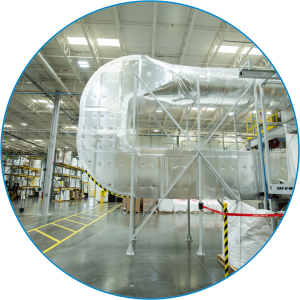
ARAMCO Dust Rejection Rig
For example, the automated process allows repeatable prototypes to be produced without the variations found in hand made prototypes and with all the production variables recorded so the exact same design can be exactly repeated in future if needed. This also enables prototypes to be built with known but subtle differences allowing accelerated optimisation of a new design. Prototypes built on the automated line are also much closer to production grade and so it is much easier and quicker to get approval to install these onto a gas turbine for scatter and BETA testing purposes, shortening the time needed to obtain real-world experience and thus the overall development cycle.
Building prototypes directly on the manufacturing line also eliminates any potential issues with scaling up from a manual construction or a pilot production line. It also becomes much easier to build large quantities of prototypes for larger testing programmes as the product development process evolves. This approach means that the many of the lessons learnt from the current automation line and the various technologies used in the build of the filters will be incorporated into any future designs. The modular nature of the different manufacturing cells also means individual improvements to areas of the product, or the processing line can be performed without impacting the whole line.
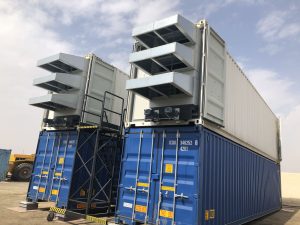
Mobile Test Rig
With the longer filter service life, reduced environmental footprint and multiple operational advantages the Tri-Dust Plus filter represents a significant gain for consumers and a substantial environmental benefit in terms of the CO2e savings that can be achieved through advanced filtration system design and the automated techniques that are required for modern manufacturing. Today the Tri-Dust Plus filter is the only gas turbine filter that is produced in a fully automated facility. Given its clear advantages that stem from its ingrained design philosophy of reduce, reuse and recycle, that shows.