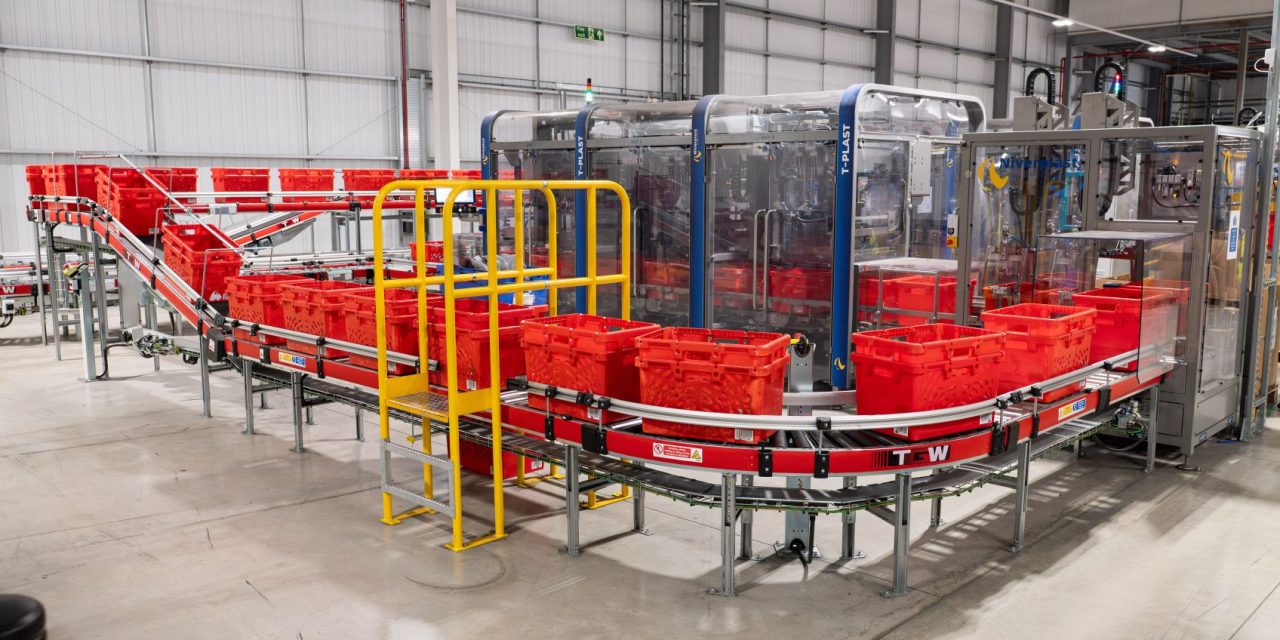
As a world leader in online grocery technology, Ocado has long been at the forefront of grocery automation by providing the advanced automation, robotics and software that power some of the most efficient and responsive fulfilment operations globally.
As the enabler behind rapid customer fulfilment for Ocado and Morrisons in the UK, Kroger in the U.S., Sobeys in Canada, and other leading retailers worldwide, Ocado’s platform combines cutting-edge engineering with intelligent data systems to deliver faster, more accurate, and more sustainable grocery deliveries.
Its customer fulfilment centres (CFCs) are designed around one simple promise: to deliver every order within a one-hour slot. To maintain its 99% on-time dispatch rate and 99% order accuracy, every process must run like clockwork — from item picking to van loading.
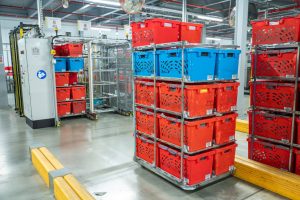
For 20 years, one part of this process remained manual: lifting heavy totes filled with groceries onto van frames for delivery. Each tote can weigh up to 20 kilograms, and every van frame holds four stacks of boxes. Now, that physically demanding, time-critical job has been automated, thanks to Ocado’s Automated Frame Loader (AFL), powered by Beckhoff control technology.
“Previously, lifting those heavy totes into one of the multiple positions on a frame could be a really physical, demanding job that didn’t suit everyone,” explained Cliff Bailey, new propositions director at Ocado Intelligent Automation. “This meant that it was a challenge to find people who wanted to do that role in the facility. The frames aren’t always perfectly square because of wear and tear, so the challenge was creating a machine that could look at the frame, identify exactly where each tote needed to go and place it precisely — just like a person would, only faster and more accurately.”
Smarter loading
The AFL automates the final stage of grocery dispatch, loading up to 350 totes per hour onto van frames with zero human touch. This innovation not only eliminates one of the most physically demanding and injury prone roles in the warehouse but also ensures consistent accuracy and speed, vital for Ocado’s on-time delivery promise .
The machine operates continuously, up to 20 hours a day, and dynamically scales throughput in response to order volumes. “The AFL helps us on our ongoing journey to improve site productivity,” added Bailey. “It is a scalable, flexible solution, that responds in real time to the demands of the operation.”
Ocado turned to Beckhoff’s integrated automation and control platform to power the AFL. Each AFL is equipped with a Beckhoff C6017 Industrial PC. Compact and powerful, the IPC coordinates all AFL motion, handling both control and functional safety within a single system.
Mounted directly on a DIN rail inside the control cabinet, the C6017 communicates with Beckhoff TwinSAFE I/O terminals — safety-rated components that centralize safety control from multiple sensors and devices across the AFL. This ensures that every movement operates with absolute precision and reliability.
“Ocado needed a compact, high-performance control system that could handle motion, safety and communication in one,” explained Bradley McEwan, business development manager at Beckhoff UK. “The C6017 IPC combined with TwinSAFE I/O provides exactly that — integrated functional safety, deterministic control and the ability to expand easily as new features are added.”
The IPC and EtherCAT-based I/O architecture allows for seamless integration of vision systems, which can help locate tote positions on imperfect frames. This precision ensures that even if a frame is slightly misaligned, the AFL can still place totes accurately, maintaining the integrity of every load.
 When designing the AFL, Ocado evaluated several automation platforms but ultimately selected Beckhoff for the flexibility, scalability, and openness of the system architecture. “The application required us to control multiple motors precisely and integrate a vision system within tight space and cost constraints,” Aquiles Calderon Santana, engineering manager at Ocado said. “Beckhoff’s platform allowed us to do that. EtherCAT gives us the speed we need for motion control, and TwinCAT provides flexibility in software. It’s also cost-effective — we can scale, add I/O easily, and deploy software remotely across global sites.”
“Beckhoff ensures supply chain resilience through seamless connectivity with virtually any open fieldbus or IT protocol,” said Doug Schuchart, global intralogistics manager at Beckhoff. “This openness minimizes engineering effort over the system’s lifecycle while enabling straightforward system expansion as facilities evolve.”
Remote deployment was a major advantage. Ocado’s operations span multiple continents, and its engineering teams must be able to update and support machines worldwide without constant travel.
“Remote software deployment is key for us,” continued Calderon Santana. “With Beckhoff, we can push updates and make adjustments from the UK to a site in Japan or the U.S. This remote capability is crucial for reducing downtime and ensuring consistency across every facility.”
The TwinCAT software platform enables integration into CI/CD pipelines and allows validated operating system updates, PLC code, and safety logic changes to be administered centrally and automatically rolled out to globally deployed assets.
Collaboration and integration
The partnership began when Ocado’s engineers visited Beckhoff’s UK technology center to explore live applications and test sample units. From there, Ocado tested Beckhoff hardware and software in-house before standardizing on the platform for the AFL.
“The Beckhoff team was proactive from the start,” said Calderon Santana. “They took the time to understand what we were trying to achieve and provided expert guidance on how to get the best out of their technology. That level of engagement has continued as we look to roll out Beckhoff technology in other machines.”
Beckhoff engineers visited Ocado sites to observe the AFL in action and ensure optimal configuration. However, Ocado’s internal engineering team handled most of the implementation directly — a testament to the ease of integration.
“It was straightforward to adopt,” added Calderon Santana. “Even though it was a new platform for us, the system architecture was intuitive and we didn’t need complex co-integration. Beckhoff’s support made the transition smooth.”
Safety and reliability at scale
In high-throughput facilities, where tens of thousands of orders move each day, safety and uptime are non-negotiable. Beckhoff’s TwinSAFE system consolidates all safety functions, from emergency stops to interlocks, into the same EtherCAT network that runs standard I/O, simplifying wiring and reducing latency.
“With TwinSAFE, safety isn’t a bolt-on feature — it’s fully integrated,” explained McEwan. “The TwinSAFE logic is part of the same TwinCAT project environment meaning incorporating functional safety into the machines is seamless. This reduces programming and integration time and improves diagnostics during both commissioning and normal operation.”
For Ocado, reliability is critical. A breakdown in the AFL could delay van departures and disrupt delivery commitments. The Beckhoff hardware and software ensures continuous operation and the Ocado equipment can run all day with minimal intervention. Combined with predictive monitoring via Ocado’s own analytics tools, the result is a resilient, self-optimizing system. EtherCAT’s efficient bandwidth utilization makes it ideal for collecting large volumes of data to support predictive maintenance strategies.
Because all EtherCAT devices on the network are typically updated within a single frame, ample bandwidth remains available for continuous data acquisition on the fieldbus. Beckhoff controllers further enhance this capability with high memory capacity (RAM) and large, removable media drives, enabling data to be stored and analyzed locally at the edge.
Cybersecurity and connectivity
Given the scale and global reach of Ocado’s automation network, cybersecurity is a key consideration for any new technology.
“Cybersecurity is incredibly important for us,” said Calderon Santana. “Every piece of technology that enters our system must meet a very high bar. Beckhoff’s platform integrates well into our internal cybersecurity framework, which is modular and designed to manage risk across all control systems.”
While Ocado’s cybersecurity tools are developed internally, Beckhoff’s open architecture ensures compatibility with Ocado’s monitoring and traceability systems, enabling secure data exchange between the AFL and the wider warehouse management network.
Empowering people
The success of the AFL means Beckhoff and Ocado are already working on future Ocado machines under development within the business.
“Our strategy is to build flexibility into every control system we design,” said Calderon Santana. “Beckhoff enables that. Every new machine we’re developing is assessed with Beckhoff technology in mind, because it gives us the scalability we need.”
Bailey added that Beckhoff’s involvement goes beyond hardware: “The team has been genuinely engaged in supporting our growth — not just supplying technology but helping us connect with others and explore new ideas. It’s a true partnership.”
Looking ahead, Ocado plans to expand its automation technology beyond grocery, applying the same innovations to pharmaceuticals and clothing, among other product areas. The AFL, equipped with Beckhoff technology, provides a modular foundation for these ventures. New technology from Beckhoff is also being tested and considered by Ocado including. PLC++ and TwinCAT for Linux. These developments will allow further integration into Ocado’s automated build and verification pipeline, increased programming efficiency and faster execution time in the machine. Furthermore, the support of containerisation with TwinCAT opens the door for more modular and efficient machine design.
At a site in Luton, England, Ocado’s most advanced CFC yet, automation has transformed grocery fulfilment. The facility handles up to 65,000 orders per week with 99% on-time dispatch, and its automation allows an order to be picked almost an hour faster than traditional store picking.
With Beckhoff control at the heart of the AFL, Ocado has automated the final stage of its fulfilment process, creating a seamless, fully automated path from supplier to doorstep.
“Beckhoff’s technology helps us deliver on our core promise to customers — accuracy, reliability and on-time delivery,” concluded Bailey. “It’s a critical part of how we make convenient and great-value online grocery deliveries not just possible, but sustainable.”