There exist a plethora of reasons manufacturers are adopting automated processes; from an increase in product throughput, to an improvement in quality output. Though one reason above all others is resonating with many business owners – to remain competitive.
As consumer demand increases, manufacturers are redefining their production processes, through the adoption of automated processes; supporting both future growth opportunities and consistency of reliability on the production line. As a result manufacturers can continue to give their customers what they want.
One such company who have witnessed an increase in product throughput and quality output as a result of implementing automated manufacturing processes, is Rotherham based ZND; Europe’s largest manufacturer of temporary fencing and pedestrian barriers.
The firm have historically relied on majority manual processes, though in doing so, product quality was being compromised and production costs were raised.
The barriers are assembled via an automated process that presents a partially finished article end of line. The components of the partially completed barrier, prior to the installation of the automated cells, were welded by hand. Though in doing so, presented a problem. The welding process was effectively penetrating the material and compromising the galvanised coating; the zinc top layer that prevents rusting. So to counteract this effect, ZND had to essentially introduce another process that would correct any weakness created by the weld; respraying the product with zinc (galvanising) that was reduced, even omitted during the welding process.
Despite the respray, product quality was still not at a premium which ZND required. They also had to consider the additional cost of this secondary process.
In a bid to refine the production process, achieve cost savings against their existing processes and achieve an increase in product throughput, ZND reached out to KUKA, in an effort to understand how they could embrace automated processes to support their growing operations.
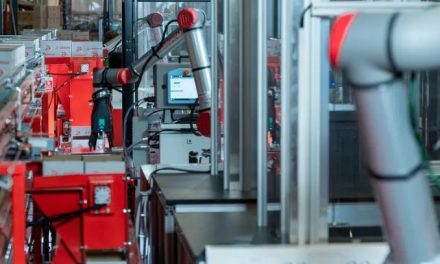
 The cell that was proposed to ZND consisted of four KUKA robots. Three of which would be implemented within a brazing cell; it had been identified that brazing, a process of hot solder ‘gluing’ removed the risk of stripping the galvanised top layer and would produce a stronger finish and ultimately a better quality product. At end of line a fourth KUKA robot would present the partially completed barrier to the brazing cell for completion. After the braze had been applied, said robot would then remove and stack the finished article for onward distribution.
Efficiency and affordability were two domineering factors at the forefront of ZND’s decision making process. Their objective; increased production volumes according to increased product demand and improved product quality.
One cell was initially installed on one of two production lines. Four robots working together in a process that had historically required the man power of 16, whom on any one shift were able to produce 80 barriers.
Such was the success of the initial install, production volumes leapt, from 80 units to 500, per shift, some 400% and a significant improvement in the strength and quality of the finished barriers was also achieved.
A second install soon followed which enabled ZND to produce a staggering 1,000 barriers per eight hour shift. In all, eight KUKA robots across two production lines, producing in excess of a quarter of a million barriers per year.
The implementation of these two automated cells at ZND have allowed them to invest in additional man power to manage the increased product volumes. There exists a misconception that the adoption of automation can have a detrimental effect on the necessity of human intervention within a manufacturing environment, this is not the case. Operatives have been upskilled and roles redefined as the manufacturing process has evolved at ZND.
Demand for ZND’s products is increasing as a result of their implementing automated robotics into their operations. Their ability to meet supply versus demand has positioned them as a market leader in the manufacture and supply of high quality temporary fencing, hoarding and pedestrian barriers.
With high profile events such as the Glastonbury Festival, London 2012 and Tea in the Park, ZND have just entered their peak period. Though not too daunting a prospect with the addition of the two brazing cells providing a reliable and consistent process at the end of their production line.
If you are attending a festival this summer and you come across a pedestrian barrier, the chances are that it would have come from ZND and been produced utilising KUKA robotic technology.