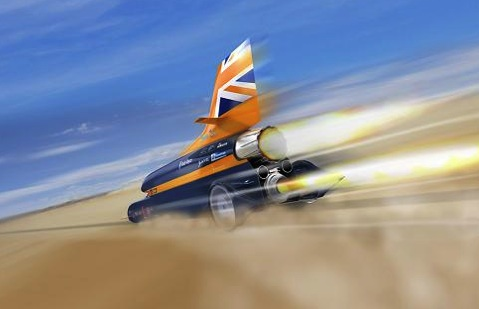
 Sensor manufacturer Micro-Epsilon UK has become a product sponsor of the BLOODHOUND SSC Project – the 1,000mph land speed record attempt that is scheduled to take place in 2016.
Micro-Epsilon UK will provide high precision sensors and measurement systems for the BLOODHOUND SSC Project that will be used throughout the testing, production and operational stages.
Micro-Epsilon’s capaNCDT 6200 high precision capacitive measurement system has been identified for in-house testing to assess and validate the dynamics and mechanical expansion of the BLOODHOUND SSC wheels.
As Joe Holdsworth, systems engineer at BLOODHOUND Programme stated, “With the wheels turning at speeds of up to 10,000rpm, this causes extremely high stresses in the wheel materials, which are solid aluminium alloy. We need to validate our FEA (Finite Element Analysis) stress models with reality and so we needed a high precision measurement system that could measure the mechanical expansion of the wheels accurately at high speed. We came across Micro-Epsilon’s capaNCDT 6200 measurement system at a recent trade exhibition (DSEI) and liked the fact that the system would enable us to synchronise measurements from all four wheel sensors during tests.”
The capaNCDT 6200 is a highly precise, integrated measuring system that includes a control unit, demodulator and Ethernet interface that supports fast and easy configuration through a web browser. The system allows up to four additional measurement channels to be added (or removed) to the base controller unit without any loss of performance or disruption. Any Micro-Epsilon capacitive displacement sensor can be connected to the controller without any additional calibration required.
As a multi-channel device with nanometer accuracy (resolution is down to 0.002µm), the capaNCDT6200 measurement system can be used in a variety of non-contact displacement, position and distance measurement applications. Measuring ranges are from 0.05mm to 10mm.
In addition, Micro-Epsilon’s optoNCDT 2300 series of laser displacement sensors will be used for on-vehicle testing of BLOODHOUND SSC during both runway trials and the record attempt itself.
Holdsworth commented, “Measuring the ride height is a critical measurement parameter on the car. We need to know the exact distance between the wheels and the ground to see how far into the ground the wheels sink during trials.”
Mounted to the car’s chassis with the laser window pointing down towards the ground, the optoNCDT 2300 high speed sensor will accurately measure and monitor the ride height of the car. The sensor will enable the BLOODHOUND SSC team to adjust the suspension characteristics in order to optimise the performance of the car.
The optoNCDT 2300 is a self contained laser displacement sensor that requires no separate controller, which provides an extremely high measuring speed of up to 50kHz. The sensor is well suited for high speed dynamic applications such as vibration measurement or for measuring uneven, difficult surfaces. Unlike many competing sensors, the optoNCDT 2300 achieves high resolution and high measuring speeds without any averaging. The sensor can also be configured remotely using a web browser interface. This direct connection means the user can store parameters for a particular application, which can then be uploaded to one or multiple sensors, reducing set-up time considerably.
The optoNCDT 2300 is available in five models with measuring ranges from 2mm up to 100mm. Resolution is down to 0.1µm and linearity is down to ± 0.4µm. Data output is via Ethernet, RS422 or EtherCAT.
A variety of non-contact infrared temperature sensors from Micro-Epsilon are being considered by the BLOODHOUND SSC team for measuring the temperature of a range of engine bay components during runway trials and the record attempt. As Holdsworth explained, “As many components on the car are bonded using adhesives and rivets, we need to know how hot these areas become during trials and runs because the adhesives are sensitive to temperature. We also need to measure the temperature of various electronics systems on the vehicle. These temperature sensors will also potentially be used for safety systems.”
The BLOODHOUND SSC team are therefore utilising Micro-Epsilon’s thermoMETER CSmicro series and thermoMETER CThot series of non-contact infrared temperature sensors.