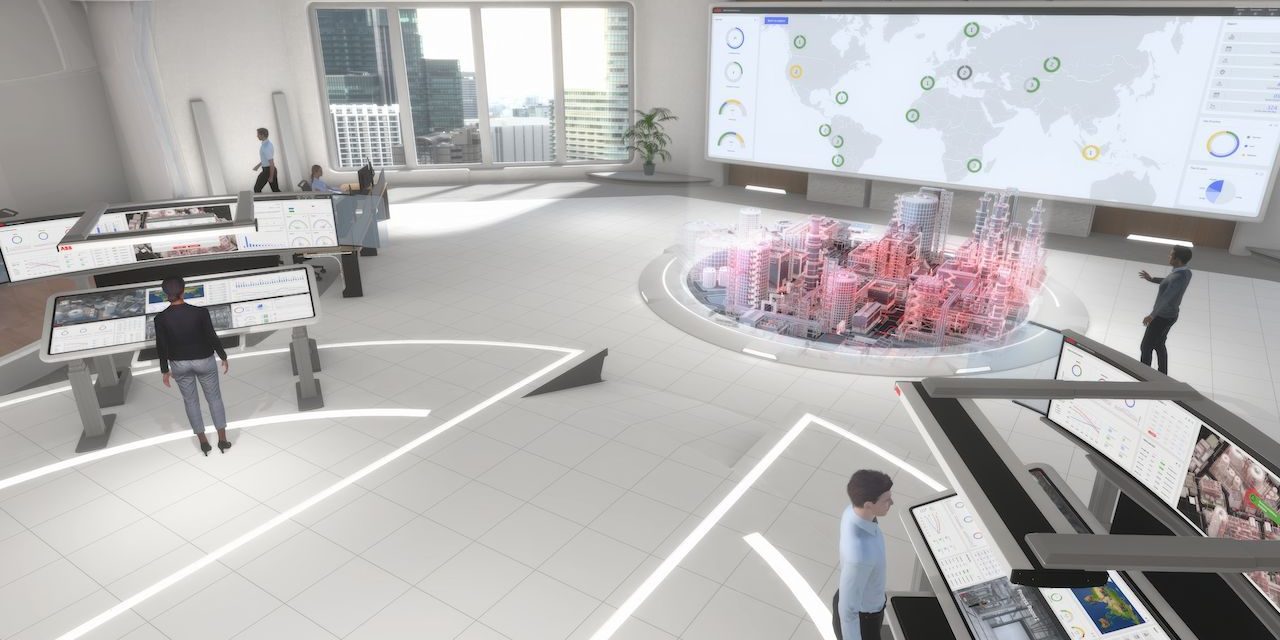
Above: DCS automating tomorrow – panoramic control room
The proliferation of edge devices across industrial processes provides plant operators with more data and valuable insights than ever before. This field-level intelligence can unlock unprecedented process optimisation, efficiency, and cost reductions. Yet, the benefits of big data shouldn’t come at the expense of real-time mission-critical control systems that process plants rely on. Kim Fenrich, Global Product Marketing Manager, ABB Process Automation, illustrates how to resolve this tension by leveraging edge intelligence and lifecycle separation effectively.
Edge computing is a defining feature of Industry 4.0 and the Industrial Internet of Things (IIoT) that can optimise processes, maximise efficiency, and help the bottom line. Yet, soaring data volumes from the field are putting existing Ethernet-based and fieldbus infrastructures to the test, threatening the long-term stability and real-time capabilities of control architectures underpinned by Distributed Control Systems (DCS). The core challenge here is how to gather and process valuable data from the field without overburdening the system. The solution lies in leveraging the latest advancements in edge computing and AI to unlock true edge intelligence and provide the ability to process data and make decisions in real time, at source.

DCS automating tomorrow – open systems architecture
Unlocking intelligence at the point of data production
Edge computing is one of the bedrocks of Industry 4.0, providing plant operators with access to maintenance, health, and performance monitoring data, captured by edge devices throughout the production line. This valuable information has the potential to enable better-informed decisions, leading to process optimisation and greater efficiency. Yet, until recently, edge computing had limited storage and processing power. Consequently, this field-level big data still required remote processing, which could overburden the communication infrastructure and delay crucial decision-making.
Today, AI is augmenting the capabilities of edge computing, making it possible to leverage real edge intelligence. In this way, equipment and systems throughout the plant gain the necessary storage and processing power to enable real-time, autonomous decisions at the point of data collection. This ability to gather and analyse data locally, without needing remote processing, is ideal for industrial environments such as hazardous areas where reliable data transmission via traditional Ethernet-based infrastructure isn’t an option.
Edge intelligence can also take process optimisation one step further by connecting plant-level edge systems with cloud computing. Local systems continuously learn from operational patterns while cloud-based analytics gain valuable insights from them to enact optimisation strategies across multiple facilities.
Lifecycle separation is key
Another core benefit of edge intelligence is that it enables crucial lifecycle separation that protects and enhances the long-term stability of deterministic controls.
This dual-layer architecture separates mission-critical DCS from asset management tools for maintenance, health, and performance monitoring. This approach, based on the NAMUR Open Architecture (NOA) model, enables process plants to future-proof their edge intelligence capabilities, upgrading and scaling this infrastructure with the integration of best-of-breed solutions from different vendors. In parallel, the DCS not only continues to operate normally, remaining untouched by streaming, computing, and analytics of big data; it also benefits from real-time data processing and storage at the edge.
There are several benefits to this approach. First, it protects critical real-time control functions against cyberthreats and other security risks. Second, it handles larger volumes of field-level data at source and makes it accessible to higher-level Monitoring and Optimization (M&O) applications, on-premise or in the cloud, without burdening the DCS. In this way, the core control is protected against data overload, safeguarding its critical real-time responsiveness.
Intelligent maintenance
Thanks to edge intelligence and lifecycle separation, maintenance teams can access data directly through asset management applications from any location, collaborating more effectively. This approach leads to early warning detection, faster troubleshooting, , and predictive maintenance, which reduces unplanned downtime and lowers maintenance costs.
Following the NAMUR NE107 standard, diagnostic data helps operators and maintenance personnel identify possible causes of failure and provides clear guidance on how to resolve problems with field instrumentation.
This new approach to maintenance also leads to the development of machine learning models that can be deployed to edge locations, adapting to specific conditions. In this way, any faults detected locally trigger automatic analysis across the entire fleet of instruments, preventing similar issues across operations.
Giving the process industry an edge
Edge devices are here to stay, and their use will grow in years to come, with AI augmenting their ability to collect data. Unsurprisingly, the global industrial edge market is expected to grow at a CAGR of 13.4% from 2025 to 2030[1]. By routing diagnostic and monitoring data outside the DCS, this approach empowers plants to constantly improve their operations and efficiency without compromising the reliability of mission-critical control systems.
References:
[1]. Grand View Research – Industrial Edge Market Size & Share, Industry Report, 2030