 In the dynamic landscape of modern commerce, the demand for efficiency, speed, and accuracy has propelled logistics companies and supply chain managers to explore innovative solutions. Among these solutions, robotics and automation have emerged as game-changers, revolutionising the way goods are handled, transported, and delivered. But what are the key drivers and reasons behind the increasing adoption of robotics and automation in logistics, with a focus on mobile robots, modular cells, and mobile cobots?
- Efficiency and Precision:
One of the primary reasons logistics companies are turning to robotics is to enhance efficiency and precision in their operations. Traditional manual processes are prone to errors and inefficiencies, leading to delays, inaccuracies, and increased operational costs. Mobile robots, equipped with advanced sensors and AI algorithms, can navigate warehouses with agility, performing tasks such as picking, packing, and sorting with unparalleled precision. This not only reduces errors but also significantly accelerates order fulfilment, meeting the ever-growing demand for faster and more accurate deliveries. - Rising Labour Costs and Workforce Challenges:
As labour costs continue to rise, logistics companies are faced with the challenge of maintaining competitiveness while managing operational expenses. Automation, particularly in the form of modular cells, offers a solution by reducing dependencies on human labour. These modular cells, often consisting of robotic arms and conveyor systems, can be seamlessly integrated into existing warehouse infrastructures. They handle repetitive and physically demanding tasks, allowing human workers to focus on more complex and strategic aspects of the supply chain. This not only addresses labour shortages but also creates a safer working environment by minimising the risk of injuries associated with manual labour.
- 24/7 Operations and Scalability:
Logistics operations are no longer confined to traditional working hours. E-commerce and global supply chains demand continuous, round-the-clock operations to meet customer expectations for swift deliveries. Mobile robots and automation enable logistics companies to achieve 24/7 operations without compromising on efficiency. These robots can work tirelessly, covering vast warehouse spaces and completing tasks efficiently, contributing to increased throughput. Additionally, the modular nature of these automated solutions allows for easy scalability. As demand fluctuates, logistics companies can adapt by adding or reconfiguring robotic modules to meet changing requirements, providing a flexible and scalable solution for evolving business needs.
- Advanced Analytics and Data-Driven Decision-Making:
The integration of robotics in logistics goes beyond physical tasks. Automation systems generate vast amounts of data through sensors, cameras, and other technologies. This data is invaluable for logistics managers, providing insights into operational performance, inventory levels, and overall efficiency. Mobile robots equipped with AI algorithms can optimise routes, predict maintenance needs, and adapt to changing warehouse conditions in real-time. This data-driven approach enables logistics companies to make informed decisions, improve resource allocation, and optimise the entire supply chain for enhanced performance and cost-effectiveness.
- Collaborative Robotics (Cobots) for Human-Robot Synergy:
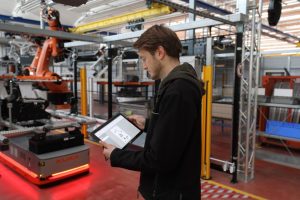
While some tasks are best suited for automation, there are scenarios where human intuition and problem-solving skills are irreplaceable. Mobile cobots, or collaborative robots, bridge this gap by working alongside human employees. These cobots are designed to collaborate with humans in shared workspaces, enhancing productivity and safety. In logistics, mobile cobots can assist with tasks that require dexterity and human judgment, such as complex picking and handling of fragile items. This collaborative approach optimizes efficiency while maintaining the human touch in certain critical aspects of logistics operations.
Conclusion
The transformative impact of robotics and automation on logistics and the supply chain is undeniable. The adoption of mobile robots, modular cells, and mobile cobots is reshaping the industry, driving efficiency, reducing costs, and enhancing overall performance. As technology continues to evolve, logistics companies that embrace these innovations will position themselves at the forefront of the industry, ready to meet the challenges and opportunities of the rapidly changing global market. The synergy between human expertise and robotic capabilities heralds a new era in logistics, where the marriage of innovation and tradition propels the industry into a future of unprecedented efficiency and reliability.
Why not speak to us about our many industrial applications, designed specifically for the logistics and supply chain industries: sales.uk@kuka.com 0121 505 9970