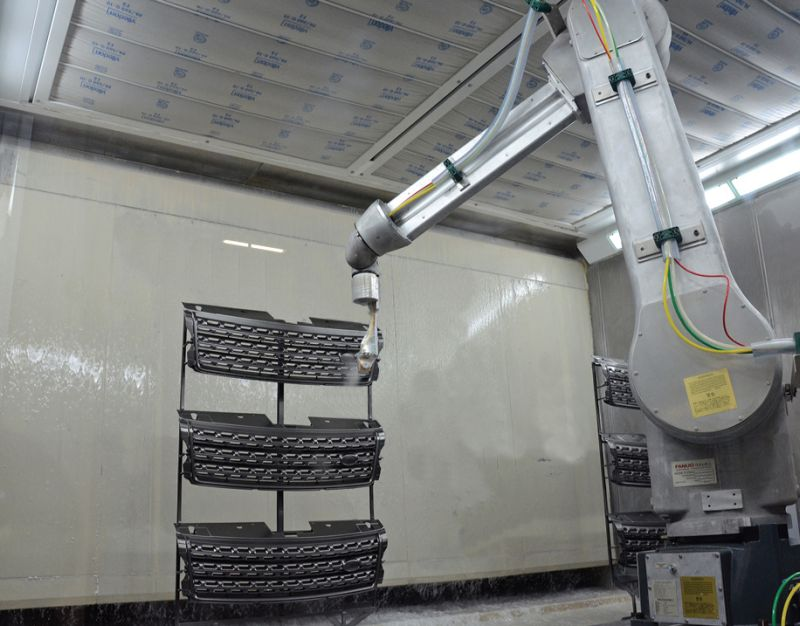
 Only twelve months after launching two new paint robots, FANUC has supplied 32P-250i robots into three UK manufacturing sites. The figure exceeds the total of all paint robots installed in the UK over the last three years by 151%
Driven by the technological demands of coatings such as 2K polycarbonates and the need for consistency and quality, FANUC has incorporated many enhancements into the latest robots that increase production efficiency and reduce paint wastage. The FANUC P-50iB and P-250iB are designed with features that make them well suited for automotive finishes and general industrial use.
 The P-50iB has an ultra compact design but manages to provide a large working envelope, with 1.4m and 1.8m reach variants. Added to the option of mounting the robot to a wall or a ceiling, the compact design allows booth size and therefore volume of extracted air to be kept to a minimum.
With a payload of up to 15kg the P-50iB allows all types of spray gun, applicator and accessories to be used precisely, with rapid and accurate path control to optimise quality and to reduce overspray.
In common with the P-250iB, the P-50iB has an open J3 arm onto which process control equipment can be mounted. The purged J2 arm includes provision for one or two servo motors to drive gear pumps for accurate 1K or 2K material metering or mixing. The arm also provides a mounting for the colour change valves ensuring they are as close to the applicator as possible – reducing the volume of material lost during colour change. With only a short internal paint line through to the wrist to the applicator, this makes the arm easy to clean and minimises contamination experienced from external paint lines.
The larger P-250iB has a two metre reach and will accurately handle a 15kg payload at high speed allowing rapid reorientation for both conventional or Bell applicators. The robots can be mounted in many configurations – floor, ceiling or even wall. They can also be mounted on rail units to increase the work envelope. A lightweight plastic forearm variant is also available for water-based electrostatic applications.
Many options are available for all of the FANUC paint robots including process valve options for the P-50iB and process speed options for the P-250iB, including auto-colour changers, spray pattern and parameter control and line tracking.
Compliance with explosion protection is certified for both robot ranges according to CE standards, ATEX II 2 G and 2 D and North American Standards (Class I,II,III).
Both robots are controlled by the new energy saving R-30iB controller, FANUC’s latest generation of intelligent controller, which includes smart features and application specific user software.
Increasing capacity
In other news Norbar Torque Tools has upgraded its welding facility with a new robotic welding cell engineered by Cyber-weld. Providing Norbar with increased capacity, quality improvements and at the same time taking up less space, the new system is based around a FANUC ARC Mate robot.
Using robotic welding solutions isn’t new to Norbar – a welding cell with limited capabilities had been in use for many years and had come to the end of its effective supportable days. Norbar’s production engineering team were specific in that they needed to speed-up the welding process for its Industrial Torque Wrench range.
John Hooley, production engineer, Norbar, explained, “Providing calibration support across four continents, a continuous new product development programme and strong customer loyalty for Norbar torque products is driving our growth. Recent investment in a new facility provided the opportunity to upgrade our welding process.
“The existing system had reached a stage of spares obsolescence and by its design made tool changing, maintenance and any level of equipment access difficult and time consuming. The welding process produced a lot of spatter which required a lengthy linishing operation.”
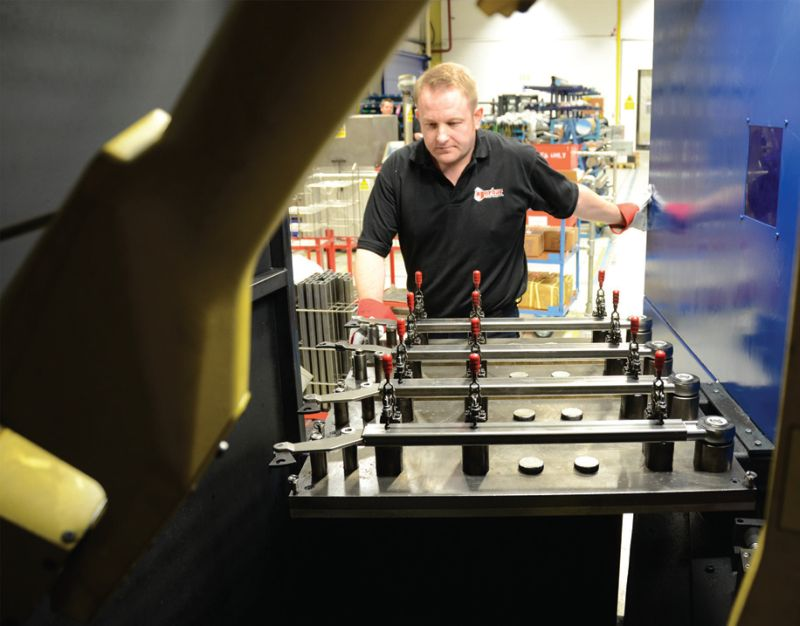
Cyber-weld, a strategic partner of FANUC for welding applications was selected to engineer and supply the replacement system. Designing what is essentially a ‘plug and weld’ robot cell comprising a FANUC ARC Mate six axes welding robot, an integrated MIG welding power source, turntable and fume extraction, the complete system was delivered as one complete product and fork lifted into position.
Requiring only power and gas supplies, the system was available for pre-production trials and commissioning within hours of its delivery. Hooley continued, “Cyber-weld’s in-depth knowledge of both the welding process and robotics made the process very straightforward – we were able to carry out trials before delivery and quickly realised the increased flexibility we had with the efficient integration of the welding package into the FANUC robot control system.
“The reduction of spatter has virtually eliminated the need for linishing after welding. Added to this the high welding speed of the FANUC and being able to multi-load components while welding continues, the Cyber-weld system has helped us to reduce a typical batch weld time from four and a half hours to two and a half.
“The success of the system, its transition and minimal disruption to production is down to the preparation we carried out with Cyber-weld. It became clear early on in our discussions that the Cyber-weld team are passionate about robotics and welding with an in-depth knowledge to carry it all through.”
FANUC UK
T: 0247 663 9669