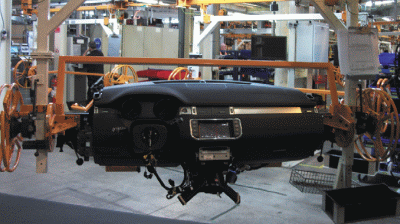
 Automation control system specialist Denca of Widnes, Cheshire, has assisted the supplier of mass-produced assembled components for the automotive industry, IAC Halewood, with the installation of an additional 15 power trolleys into its Land Rover dashboard production line.
The overhead EMS monorail conveyor system has three phase power, single phase control and an earth rail for each trolley, or carrier, having its own onboard motor and VSD box connected to the EMS monorail via Flexible Brush assembly.
Denca’s remit involved executing the electrical and software design to increase the number of trolleys on the line, supplying all the electrical components including the LJU trolley boxes, the EMS monorail bus bar system for the extension, cabling of the trolleys and all additional sensors, repositioning of existing sensors, updating the PLC and SCADA software for the additional trolleys/operational changes, modifying the existing panels to take the extra hardware and cabling and incorporating a tagging system to enable operatives to track and predict the arrival of individual components.
Denca produced the function design specification and its client, Tracoinsa, provided project management and all mechanical design and fabrication aspects of the project, including structural steelwork for the overhead EMS monorail extension using its patented extruded aluminium channel to carry the power trolley bus bar system and manufacture new trolleys.
Fifteen new LJU boxes were supplied each with the capability to adjust the speed the motor runs and to complement the existing two-speed trolley boxes. In addition DC Tooling ‘Smart boxes’ were built and installed at each new operator station to enable the individual work stations to interface to the Power trolley PLC control system so that the PLC is aware of the location and status of each trolley.
Significantly, a new repair leg was also added to the system to take any trolley boxes with instrument panels that have been assessed by the operator after testing as needing repair.
Entry to the repair leg is controlled by a dual direction motor which actuates the entry switch points, only if the operator identifies the part as needing repair. Exit from the repair leg is similarly controlled by the operator via the exit switch points.
Denca completed the entire project within a four month timeframe which involved a shutdown of a mere two weeks for installation and recommissioning.