The UK manufacturing sector stands at a crossroads. Confronted with labour shortages, rising operational costs, and increasing demand for customised, high-quality output, manufacturers are urgently seeking solutions to sustain productivity and competitiveness. Julian Ware, UK & Ireland Sales Manager for ABB Robotics, explains how Artificial intelligence (AI) integrated into industrial robotics is emerging as a key enabler with the potential to transform the UK’s manufacturing future.
For those who are passionate about raising the UK’s manufacturing productivity, it has long been a source of frustration that the UK continues to trail many of our international competitors when it comes to the use of robots. With just 119 robots per 10,000 workers[1] in 2023, described by the International Federation of Robotics (IFR) as ‘very low for a Western European country’[2], we lag far behind nations such as Germany and South Korea as well as countries that we wouldn’t normally have seen as close competitors.
Encouragingly, as automation becomes more accessible and advances such as simplified programming and AI lower the barriers to adoption, there are signs that this gap could be set to narrow. The UK industrial robotics market, valued at around USD 475 million in 2024, is projected to grow at a compound annual growth rate (CAGR) of nearly 13% over the next decade[3]. Much of this growth will be driven by the evolution of AI-powered robotic systems, which can function more autonomously, adapt to dynamic environments, and collaborate directly with human workers.
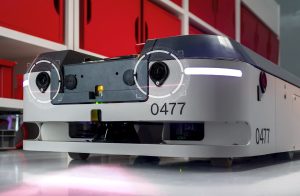
An AMR using visual SLAM navigation
The best of both worlds
The last decade has seen massive strides forward in both robots and the software used to program and operate them. Major milestones have included the development of compact robots, the evolution of cobots and mobile robots, and the arrival of software tools that enable even the least experienced users to quickly master programming robots.
Another area of development has been robot vision. Coupled with the power of AI intelligence, vision is opening new possibilities for robots to interpret and respond to their surroundings, enabling them to make decisions and adapt their performance accordingly.
Rather than replacing jobs, these robots offer new ways to augment the abilities of human workers by taking over monotonous, dangerous or ergonomically challenging tasks and allowing people to focus on oversight, problem-solving, and higher-value activities.
One of the most visible changes enabled by AI is the expansion of autonomous mobile robots (AMRs). Unlike previous generations of technology such as Automated Guided Vehicles (AGVs), AMRs do not rely on magnetic strips or fixed paths. Instead, they use technologies such as simultaneous localisation and mapping (SLAM) to navigate warehouses, identify obstacles, and optimise travel routes without manual intervention.
Companies developing such technologies have made substantial progress in simplifying the deployment of robotics, including through the development of software to remove the complexity of programming and operation. ABB’s AMR Studio software, for example, enables users to configure an AMR fleet using intuitive drag-and-drop tools, reducing reliance on dedicated programming expertise. These advances are effectively equipping robots with “eyes, hands, brains and mobility”, mirroring and supplementing the versatility of human workers whilst offering enhanced levels of endurance, precision and adaptability.
Another innovation under development will allow robots to understand spoken or visual instructions using generative AI, eliminating the need for coding altogether. These changes are significantly lowering the time and cost associated with robot deployment, while making automation viable even for companies with limited technical resources.
The impact of AI-enhanced robotics has the potential to transform a broad range of UK manufacturing sectors. In the automotive and electronics industries, for example, these systems can be used to assemble complex components at increased levels of speed and precision. Robots equipped with AI-based vision systems can identify parts, assess their positioning, and make any necessary adjustments in real time, resulting in higher quality and fewer defects.
In the food, beverage, and consumer goods sector, AI-powered automation offers the potential to improve efficiency and ensure consistency by enabling robots to adapt on the fly. This could include sorting and packaging products at high speed, adapting to variations in shape or format, and inspecting items for defects, all without interrupting the flow of production.
In logistics and warehousing, robots are already increasingly managing material flows without requiring human direction. Picking robots combining vision and AI can identify package types, decide the optimal storage location, and even adjust operations in response to seasonal demand changes. These capabilities are especially valuable as online retail and just-in-time delivery models continue to reshape the supply chain landscape.
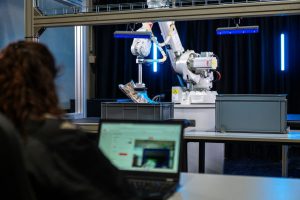
ABB robotics are used in the fashion industry
Getting workers ready for AI
Unlocking the full potential of AI-powered robotics in the UK will require continued investment in people and processes. One of the most significant challenges is workforce readiness. While robots can take on repetitive tasks, their successful integration depends on people who understand how to manage, maintain, and improve automated systems. Recognising this, industry and government bodies are expanding apprenticeship programs and training schemes focused on automation and robotics engineering.
The long-awaited UK Industrial Strategy contains various provisions for providing the necessary training to equip both current and future workers with the skills needed to work with AI and AI-enabled technologies, including robots. Measures include £275m to fund technical training and apprenticeships, including courses in AI and digital manufacturing, as well as the establishment of AI Skills Hubs to train workers in areas including advanced manufacturing and digital services.
Unlocking new possibilities for UK manufacturing
AI-powered robotics is set to evolve. Ongoing improvements in areas including cloud computing, digital twins, and industrial connectivity will see robots becoming not just more autonomous, but also increasingly integrated into a larger digital infrastructure. In the future, data collected by robots will help inform production planning, predictive maintenance, and even product design, opening new possibilities for manufacturers to link their factory operations more closely to market demand.
By reducing complexity, improving adaptability, and enabling smarter collaboration between people and machines, AI-powered robots offer a practical path forward for UK manufacturers facing mounting pressure. Whether in large plants or small workshops, the age of intelligent automation has the potential to reshape the foundation of industrial productivity in the UK.
To find out more about how robots can transform productivity, visit our Innovate, Automate, Elevate web page.
[1]. Source: Automate UK, referencing International Federation of Robotics World Robotics 2024 Report
[2]. Source: Tony Blair Institute for Global Change – A new national purpose: The UK’s opportunity to lead in next-wave robotics
[3]. Source: imarc – UK Industrial Robotics Market Overview