 Heiko Luckhaupt, Automation & Control, RS Components, looks at how sensors have become the eyes and ears of automation systems
When assessing technological progress, it is very common to focus on the massive increases in processing power that have made the machines around us progressively more ‘intelligent’, and neglect the role of the sensors.
In the industrial control arena sensors and transducers are built to suit a wide range of environments, and just as important as acquiring the signal is the conditioning and transmission system that ensures it is safely conveyed to the central processing unit.
Perhaps the most prominent trend in this arena is the dramatic increase in the use of visual information as a system input. Industry analysts IMS Research estimate that the machine vision market grew ten percent in 2011. Today, manufacturing accounts for more than 80% of machine vision revenues – but IMS also identifies a trend towards a broader use of the technology in areas such as traffic monitoring, security and surveillance, control and medical applications.
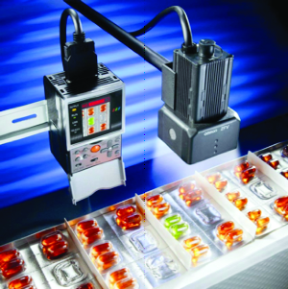
Products such as Omron’s ZFV series smart vision sensors allow engineers to implement vision systems that would have been impossible just a few years ago.
While vision systems have undoubtedly seen much progress in recent years, more traditional sensor types have also evolved rapidly. One of the most important functions that needs to be implemented is position and motion sensing, and a vast range of linear and rotary position encoders is now available. While some offer absolute encoding, the vast majority of applications can be served by incremental encoders. Typical of the new generation of such devices is the DFS60 line from SICK Stegmann.
Encoder outputs need to be chosen carefully according to the electrical environment, application and external signal conditioning apparatus. Manufacturers such as Baumer offer a range of configurations specifically designed to cope with these different requirements.
Like encoding, non-contact proximity sensing is a long established technology that is used in a huge variety of positioning applications. The trend here is to provide improved performance using a traditional underlying technology, with advances in specifications such as sensor speed, robustness and smaller size. Progress has also been made in cost reduction, and offering increased flexibility, such as the ability to run from both AC and DC power supplies.
 A product family such as the Schneider OsiSense range (pictured right) includes both general purpose devices and sensors designed for specific applications.
When position and presence detection is required on a much smaller scale, fibre optic sensors are becoming increasingly popular. Aside from their small size and their ability to detect small objects and movements, they have a number of other benefits. They are resistant to electrical noise and conversely, they do not themselves create electrical noise and, via the use of glass rather than plastic, fibre can function at elevated temperatures.
The fibre optic sensing system consists of two main components – an amplifier that generates light and senses reflections, and the fibre itself. Amplifiers are available in digital and manual types. The digital variety provides a numerical display of the sensed light value, with the switching point set digitally. Manual units provide a bar graph display and allow the switch point to be set via a potentiometer.
A number of different types of fibre can be used, with a single strand plastic fibre being the most common. For more accuracy, users can choose a coaxial configuration, in which the central core is used to transmit incident light and the smaller surrounding fibres are used to convey reflections back to the sensor. A third type, multi-core, is constructed of a large bundle of small fibres.
Conclusion
In this article, we have barely been able to scratch the surface of what is possible with modern sensor technology. As well as vision sensors, proximity switching and fibre optics, today’s automation systems can include a vast array of barcode readers, light intensity, colour and contrast sensors. In the plastics industry, and in many types of machine tool, fluid level and pressure monitoring, temperature and flow rate measurement are all important functions.
The importance of these many and varied devices is often underestimated – but make no mistake, any automation system would be lost without these vital ‘eyes and ears’.
RS Components
T: 08457 201 201