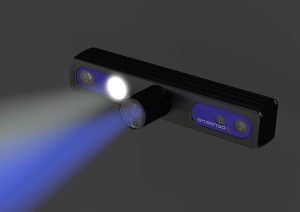
 The rapid development of robotics has led to an increasing demand for 3D camera technologies in recent years. The reason is the decisive role they play in improving the performance and versatility of robots. However, many of these applications require more sophisticated solutions that deliver much more than just depth information of the environment. Advanced image processing technologies, such as colour segmentation or machine learning, require other basic data for which additional 2D cameras were previously used. The new compact Ensenso C camera system combines a wider range of functions and features to capture and interpret 3D data more efficiently and accurately.
With an additional and fully integrated RGB camera, the Ensenso C series from IDS Imaging Development Systems now also allows access to 2D colour images of the same scene. This extends the camera’s range of applications when not only a 3D point cloud but also a colour image is required to solve a task. This could be AI-based image analyses, for example, for which colour images are usually used as basic data.
If several features or basic data are to be used and analysed to fulfil an application, this can usually be done in two ways. On the one hand, all the sensors or components required for the overall task can operate as separate stand-alone devices. Although this ensures the greatest possible flexibility in the selection and maintenance of each modular unit, the integration and synchronisation of several devices in one application is technically more demanding and therefore requires more specialist knowledge.
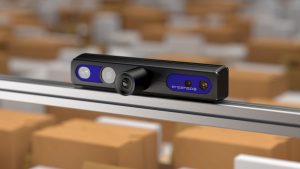 In contrast, fully integrated devices, such as the new Ensenso C, combine all components in a closed and protected housing. In other words, the stereo cameras, pattern generator, 2D colour camera and light are optimally matched to each other at the factory, adjusted and accessible via a common device software, the Ensenso SDK. Despite the increasing complexity of applications, the 3D camera system is compact enough to fit into the limited space available in robots and other autonomous systems, for example.
Particularly efficient, even with large object distances and high volumes
For applications with large object distances up to 5 metres, the components of a 3D camera system must be optimally designed and work together to achieve a high Z-accuracy of the depth values. In stereometry systems such as the Ensenso C, a large baseline, i.e. a large distance between the two stereo cameras, ensures very precise and stable triangulation of the object points. In conjunction with the high resolution of 5 MP, object structures can be scanned with great detail. For complete point clouds, even of low-texture object surfaces with only a few prominent pixels, Ensenso C cameras rely on an extremely powerful 200 W LED pattern generator, which ensures high-contrast surfaces even at a distance of 5 metres. The very rigid mechanics and optimised heat dissipation also ensure low jitter of the depth values even at great distances (0.1 mm at a distance of 1 m).
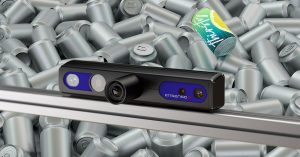 This 3D camera system combines all Ensenso advantages in the 3D vision environment in a particularly compact housing, especially in the high-end sector for large-volume applications with the highest demands on accuracy. The simple handling and commissioning of the numerous model variants makes the Ensenso C series an essential tool for image processing in the 3rd dimension.
3D camera technology must keep pace with new market requirements, which does not require a technological revolution. 3D camera systems like Ensenso C will improve the capabilities of robots and autonomous systems and open up new possibilities for precise and versatile areas of application.
IDS Imaging Development Systems Limited
Cheyenne House, West Street
GU9 7EQ Farnham
United Kingdom
Phone: +44 1252 916 656
uksales@ids-imaging.com
www.ids-imaging.com