 While robots applications have continually expanded, they have remained largely stand alone six axis machines deployed in painting, welding and traditional tool manipulation tasks. Other systems have predominantly been gantry style arrangements for work handling in, for example foods and packaging, electronics and assembly work. While such machines are programmable, they are limited by nature of their stand alone or dedicated systems installation.
Emerging is the provision of inexpensive devices that are capable of easy integration within larger systems. Systems integrators, in particular, have wanted off the shelf robot solutions that can integrate with other automation controls. This is also true of packaging and food processing machine builders and others seeking to exploit the speed, repeatability and flexibility of robots.
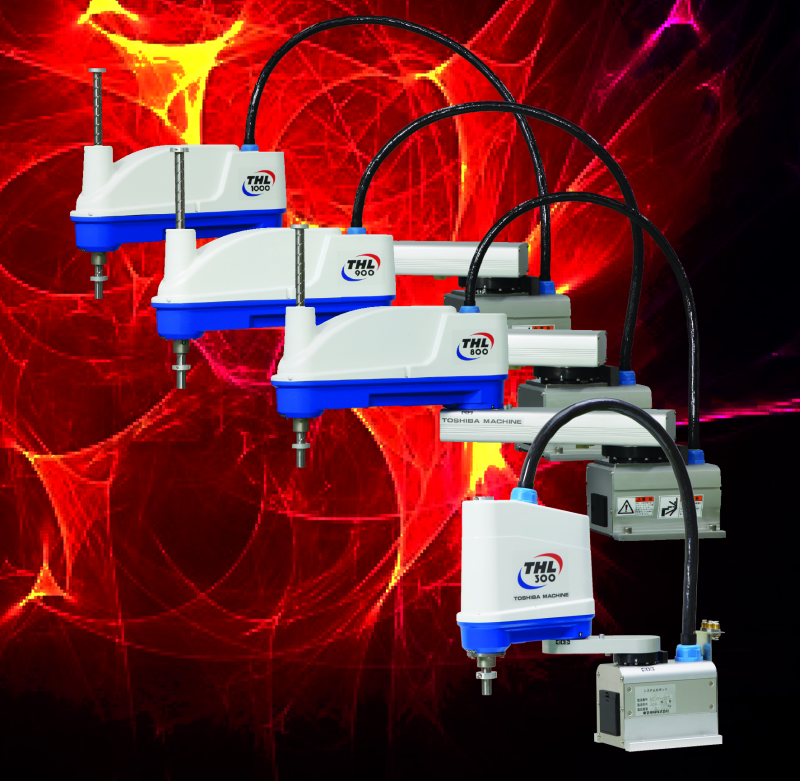
Toshiba Machine makes SCARA robots capable of sitting within machines or alongside production lines. However, with the development of its low cost, lightweight new THL SCARA robots the company has addressed the specific needs of machine builders and systems integrators. The Toshiba Machine THL range covers a range of arm reach and payload capacities in a low mass design that because of their low inertia are fast, accurate and consume less energy.
The aim of the Toshiba Machine THL design was to achieve low mass and low inertia with the necessary rigidity from which high accuracy is attained. Reduction in mass is thanks to the use of lightweight cast aluminium mechanical components that have a series of ribbed sections to provide rigidity. As a result, smaller servo motors have been fitted. Moreover, because the lightweight system generates substantially less inertia a simplified gearbox has been used.
 The THL range is up to 50% lighter than other Toshiba Machine models and the robots consume 50% less electricity. Performance compares favourably with other models and the new robots feature easier maintenance than previously.
Available from 300mm to 1000mm arm lengths, the next surprising revelation is that the complete range of models fit within just three price bands. Toshiba Machine explains that since the only difference between the robots is the length of the extruded aluminium tube that forms the arm’s main beam, the cost difference is negligible.
Each robot has four axes of movement including ±360° rotational, with a working envelope of ±125° on the first axis and ±145° on axis two. Maximum payload is up to a weighty 10kg for the larger models. The allowable moment of inertia is just 0.2kg/m2 and thanks to the use of absolute encoders repeatability in X-Y is a mere 0.01mm.
THL robots also feature less complex, easy-to-maintain gearboxes and motors. The THL’s high RPM motor results in the highest speeds in its class compared to other SCARA robots of similar size.
Low-cost and lightweight THL Series SCARA Robots are ideal for price-conscious end-users, and system integrators looking to incorporate automation. The THL800, THL900 and THL1000 are ideal for the assembly of medical devices, food packaging, pharmaceutical processing, and semiconductor and electronics.
One integration project uses a Toshiba Machine THL300 Scara robot to fix work pieces for smart phones. The location of tapped holes in the work piece is identified by a vision system. The THL300 then fixes the screws using a programmable screwdriver unit. The secured screws are then inspected before the robot unloads the work pieces.
The work pieces are contained on a turntable with six fixtures/stages. A pneumatic actuator holds down the Smartphone chassis onto the frame. This frame does not have to be high-precision because the holes are aligned using the vision system, hence the fixturing is relatively inexpensive.
The vision system passes position data to the robot controller via DeviceNet.
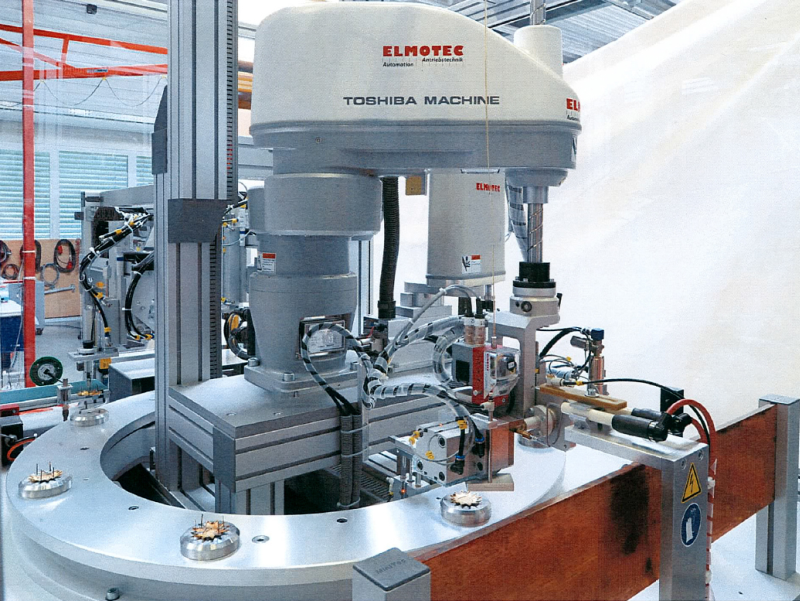 The THL300 has a programmable screw driver unit handling the small M1 screws that are just 1mm in length. For the inspection of the screws an X-Y stage is used with a probe to inspect the height of each screw. Position data from the vision system is also fed to the X-Y stage.
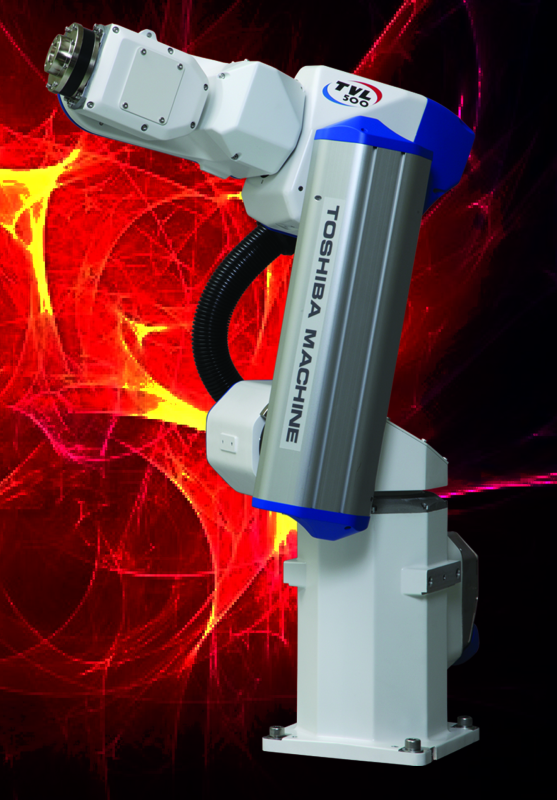
The latest addition to the Toshiba Machine range is a new low mass 6-axis robot designated the TVL500. Boasting an impressive reach of 602mm and a maximum composite speed of 7.98m/sec, the TVL500 also has repeatability in X, Y and Z-axes of just ±0.2mm and a payload of 3kg. Like the lightweight Toshiba Machine THL SCARA range, the new TVL500 has its main mechanical components manufactured from extruded aluminium and hence the TVL500 has a mass of just 28kg.
Again, the Toshiba Machine TVL500 has been designed with the needs of the systems integrator in mind. For example, there is a variety of ready tapped holes to enable fixing of external cabling and peripheral devices. Similarly, there are fixing holes provided to allow sideways mounting of the robot within a machine. A tee groove in the arm components allow tools, cabling and DIN rails to be mounted in position.