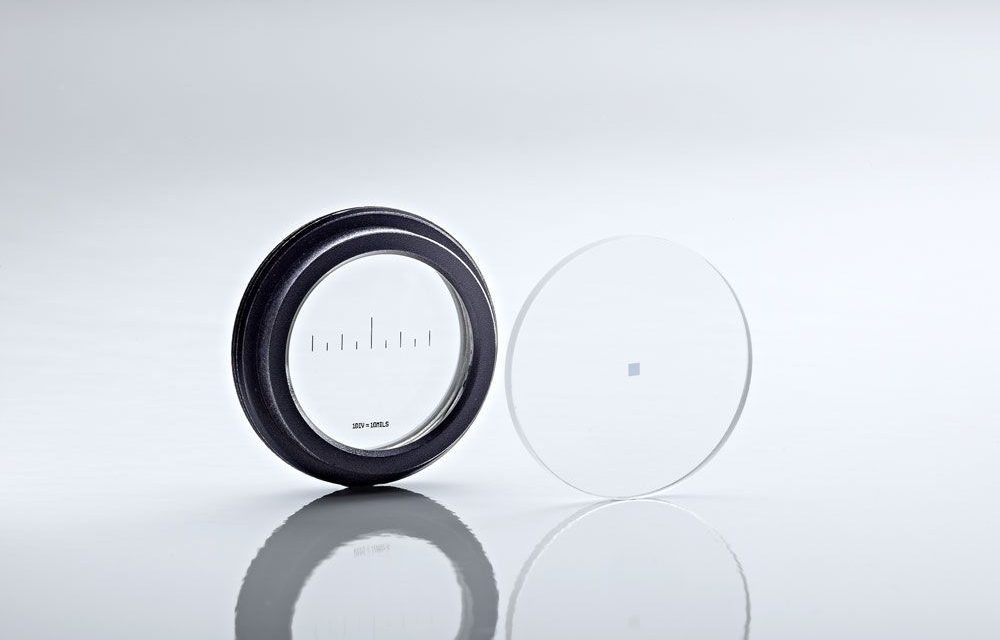
The role of reticles and graticules
Cameras, lenses and sensors are familiar parts of machine vision and automated inspection systems. Less visible are the reticles and graticules that provide the reference points used for measurement, calibration and alignment.
To make accurate measurements, imaging systems must be calibrated against a known reference. Reticles and graticules provide that reference, supporting accurate optical measurements and system setup across a wide range of applications.
Reticles and graticules are used across machine vision, metrology and scientific instrumentation, where precision and alignment are essential. Although the applications vary, each depends on a pattern manufactured to controlled dimensions and tolerances.
What is a reticle?
A reticle, sometimes referred to as a graticule, features a precisely defined pattern applied to an optical substrate. Standard and custom designs are used in measurement, calibration and alignment applications across a wide range of industries.
The pattern may be deposited onto the substrate using photolithography or chemically etched and filled with a coloured pigment. Etch-and-fill reticles, also known as illuminated reticles, use pigments such as red, black or white to provide contrast in daylight and low-light conditions.
The terminology often reflects the application. Graticules are commonly used for measurement and calibration tasks, while reticles are often associated with optical projection and alignment applications.
Why physical references still matter
Graticules provide a precise reference for measurement and calibration. Stage graticules are used in microscopy and video imaging applications, as well as loupes, magnifiers and similar handheld measuring tools.
Depending on the application, the pattern can provide a reference for measuring dimensions, diameters, radii or angles. Custom designs are available where a standard solution is not suitable.
For applications requiring a defined scale, stage graticules are available with divisions ranging from 0.1 mm to 0.01 mm, providing a physical reference for accurate measurement and calibration.
Manufacturing precision and material options
Reticles and graticules are available in both stock and custom formats to support a wide range of measurement, alignment and inspection applications.
For etched designs, Knight Optical can produce line widths down to 5 µm, while stock graticules are available with features as small as 2.5 µm, depending on the pattern and product type.
Substrate selection depends on the application. Patterns can be applied to glass, windows, filters and prisms, with substrates such as N-BK7 and UV fused silica used for applications ranging from UV to IR. Antireflective coatings can also be applied for use at specific wavelengths.
Applications across optical and automated systems
- Machine vision and automated inspection
Machine vision systems are widely used for dimensional inspection, quality control and process monitoring. These systems rely on calibrated imaging to deliver repeatable measurements and inspection results. Reticles and graticules provide this reference, enabling image scaling, measurement verification and system alignment. They can also be used during equipment setup and ongoing maintenance to help verify measurement accuracy over time.
- Robotic alignment and positioning
Automated assembly systems often rely on optical references to verify positioning and alignment. Precision reticles and graticules can be used during setup and calibration to ensure cameras, sensors and optical components are correctly aligned, helping improve repeatability in automated manufacturing processes.
- Metrology and scientific instrumentation
Graticules and reticle assemblies are used in metrology, surveying and scientific instrumentation. They can be configured for a wide range of measurement tasks, with substrate materials and feature layouts tailored to specific requirements.
What should engineers specify?
While standard graticules are suitable for many applications, measurement requirements, optical layouts and operating environments often require a custom design tailored to the system.
The graticule specification should reflect the measurement or calibration task.
Key points include:
- Pattern type, such as a scale, cross line, grid, protractor or concentric circles
- Overall dimensions and pattern size
- Line width and scale divisions
- Substrate material and thickness
- Operating wavelength
- Any antireflective coating requirements
- Whether the component is supplied mounted or as part of a subassembly
Stock graticules are available for common measurement and calibration requirements, while custom patterns, dimensions and substrates can be specified for application-specific designs.
A precise reference for automated measurement
Reticles and graticules provide the reference patterns that support accurate measurement and positioning across machine vision, metrology and automated inspection systems.
Knight Optical specialises in custom graticules and precision etch-and-fill reticles, with dimensions, materials and configurations tailored to specific optical and measurement requirements.