A vision solution from Stemmer Imaging has been implemented at a leading producer of domestic and specification radiators at Newport in Wales in order to classify radiators as they come off the production line. With a 100 per cent accurate identification rate, it is proving to be a cost-effective solution for the company Quinn Radiators’ factory boasts a fully automated production process handling 22 tonne steel coil radiators, to fully pressed, welded, pressure tested, painted and packaged domestic heating radiators.
An important part of this process is to classify radiators as they came off the production line. This information is then passed to the factory system, which in turn outputs a printed data code label so that the radiator can be tracked and identified throughout the remainder of the production, shipment and delivery processes.
With an output in excess of 40,000 radiators a week, it is essential the data coding system is reliable. The original vision system used in the factory caused the plant to be stopped up to 60 times a day because of wrong or incomplete identification. Each stoppage resulted in an average time lost of 1-2 minutes, and with production line stoppages estimated to be around £110/minute even 60 x 1 minute stops result in losses of £6,600 per day.
The measurement challenge
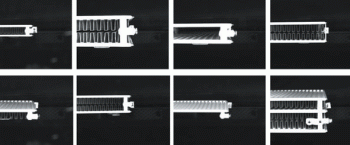
There are many different radiator types (Figure 1) and the system is required to output a code to identify the type. An example could be 2106054, where: 2 = number of waterways (1 -3); 1 = number of fins (0 – 3); 06 = 600mm height; 05 = 500mm wide; 4 = connector type (2, 4 or 6).
This means the system needs to be able to locate and measure the waterways, fins and tap connectors as well as measure the width and height of the radiator, all at a rate in excess of 190 radiators/hour. All the outputs are then added together to form a single output string followed by a Carriage Return Line Feed. This is then sent to the Quinn Factory Automation server over TCP/IP (ASCII over Ethernet).
The vision solution
A new, replacement vision solution was designed, trialled and installed by SIGA Vision. The system featured one Dalsa Genie M640 640 x 480 pixel GigE camera and one Dalsa Genie M1024 1024 x 768 pixel GigE camera together with the necessary lenses and cables and an Ethernet switch together with Dalsa Sherlock vision software, all supplied by Stemmer Imaging.
Sherlock was chosen because of its design flexibility and suite of vision tools and capabilities and support from Stemmer Imaging and Dalsa. The image processing software was installed on an existing PC next to the production line. The Genie M640 was positioned to inspect the bottom of the radiators, with a protective housing to protect it from dust and other contaminants or falling radiators. The Genie M1024 is mounted to inspect the side profile of the radiators. The higher resolution facilitates finding differences between radiators of similar sizes.
 Making the measurements
The end of the radiator is located from the bottom camera image using a vision tool which finds the extreme points within a specified region. These points are used to locate and reshape other vision tools. The next task is to find the waterways (Figure 2). This is achieved by using a connectivity (blob) tool. Once the waterways have been found, the number of fins are counted using an edge-based pattern matching tool. This tool has to handle scale variation, different image intensities and large shape changes without part confusion (Figure 3). It can be difficult to find the fins in some systems, but it is possible to allow for this using logic scripting. For example, if there are three waterways, there are always three fins. After the waterways and fins have been calculated the bottom camera determines the connector type on the end of the radiator. There are three different outputs but the models can look very different. Three separate tools with multiple patterns in each tool are used to find the correct tap connector. Again logic is used to identify the correct tap type based upon pattern matching scores and differences. The system then uses the side camera to measure width and height.
System performance
Damon Allen, improvements engineer at Quinn Radiators says: “The new system has proved to be very cost effective compared to the smart sensors we have elsewhere in the factory.
It is already operating 24 hours fault free with 100 per cent correct identification, something we could only have dreamt of in the past.”