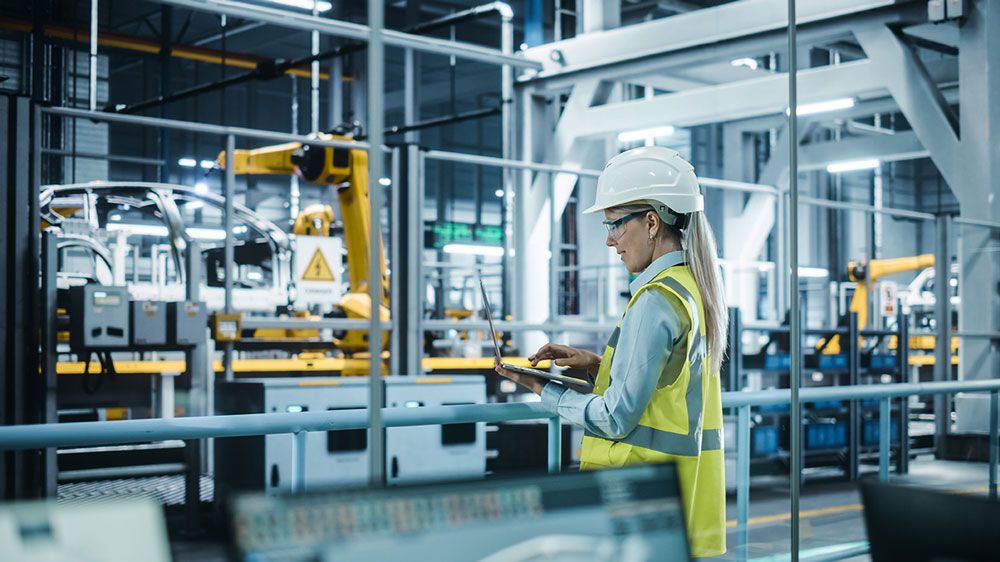
Factory automation is no longer defined by standalone machines or isolated production lines. Modern manufacturing environments are evolving into connected ecosystems where intelligent systems continuously communicate, adapt, and optimize operations in real time.
From machine vision and robotics to edge AI and industrial networking, today’s automation architectures are transforming how factories monitor quality, control motion, manage energy consumption, and improve operational efficiency.
As these technologies converge, engineering complexity grows rapidly.
Manufacturers must now design systems that handle vast amounts of sensor data, meet ultra-fast processing requirements, deliver precise motion control, and ensure secure connectivity, all while maintaining reliability, scalability, and compliance with demanding industrial standards.
The future of industrial automation depends on how effectively these technologies work together.
Smarter sensing for real-time decision-making
Machine vision is becoming a foundational technology for intelligent manufacturing.
Advanced vision systems with AI-driven analytics can inspect products, identify defects, track objects, and monitor production quality with speed and precision that traditional inspection methods cannot match. By combining cameras, sensors, and edge-based processing, manufacturers can make immediate decisions on the factory floor without relying on centralized cloud infrastructure.
This local processing capability is especially important in environments where milliseconds matter. Real-time inference enables systems to respond instantly to production anomalies, improving throughput while reducing waste and downtime.
Beyond quality inspection, machine vision also supports predictive maintenance, autonomous robotics, worker safety, and process optimization across a growing number of industrial applications.
However, deploying these systems successfully requires far more than simply adding cameras to production equipment.
Motion control remains at the heart of automation
While AI and vision technologies often attract attention, motion control systems remain essential to industrial automation performance.
Modern motor drives and inverter systems must deliver highly precise torque and speed control while operating efficiently under constantly changing conditions. Robotics, conveyors, CNC systems, and automated handling equipment all depend on fast, synchronized control loops that maintain stability and responsiveness in real time.
As industries adopt higher switching frequencies and more advanced semiconductor technologies such as silicon carbide (SiC), demands on control architectures continue to rise. Engineers must carefully manage thermal performance, electromagnetic interference, sensing accuracy, and low-latency processing to ensure reliable operation.
At the same time, motion systems are becoming more connected to broader factory intelligence platforms. Data from motors, drives, and sensors is increasingly integrated into larger analytics environments that support predictive maintenance, energy optimization, and operational visibility.
This convergence is transforming motion control from a standalone subsystem into a key contributor to intelligent factory operations.
The growing importance of edge AI
One of the biggest shifts in industrial automation is the move toward edge-based intelligence.
Traditionally, factory data was collected locally and sent to centralized servers or cloud platforms for analysis. While effective in some environments, this approach can introduce latency, bandwidth limitations, and reliability concerns.
Edge AI changes that model by enabling systems to process and analyze data directly at the point of generation.
For manufacturers, this means faster decision-making, reduced network traffic, improved operational resilience, and stronger data security. Edge architectures also make it easier to scale automation systems across multiple production lines or distributed facilities without overwhelming centralized infrastructure.
AI-enabled edge systems can now support functions such as:
- Real-time defect detection
- Autonomous robotic guidance
- Dynamic environmental monitoring
- Predictive maintenance analytics
- Intelligent safety systems
- Adaptive process optimization
As edge computing capabilities continue to expand, factories are moving closer to fully autonomous operational environments capable of continuous self-optimization.
Managing complexity through system-level design
The challenge facing many engineering teams today is not access to technology; it is integrating technologies effectively.
Industrial automation systems must now coordinate sensors, processors, communication networks, power systems, safety mechanisms, and software platforms within unified architectures that can operate reliably for years under demanding conditions.
Even small design decisions can affect overall system performance. Poor synchronization between sensing and control loops can introduce instability. Inadequate thermal management can shorten system lifespan. Unoptimized data pipelines can create bottlenecks that affect AI inference and real-time responsiveness.
This is why manufacturers are increasingly prioritizing system-level engineering approaches rather than evaluating components in isolation.
Successful automation architectures require coordination across hardware, embedded software, connectivity, power management, AI acceleration, cybersecurity, and supply chain planning from the earliest design stages.
Accelerating industrial innovation
Arrow Electronics helps manufacturers navigate these challenges by supporting the full industrial automation lifecycle.
From machine vision and motion control to embedded computing, connectivity, and power technologies, Arrow combines engineering expertise with a broad supplier ecosystem to help customers accelerate development and reduce integration complexity.
Whether organizations are developing intelligent robotics platforms, AI-enabled inspection systems, or scalable smart factory infrastructure, the goal remains the same: to enable more connected, efficient, and adaptive industrial environments.
As automation continues to evolve, the factories leading the future will be those designed not simply to automate tasks but to continuously learn, optimize, and respond in real time.