The robotics industry is undergoing a structural transformation that goes far beyond faster processors or incremental hardware upgrades. For decades, industrial robots were designed for repetition, operating in tightly controlled environments where predictability ensured reliability.
That paradigm is now giving way to Physical AI – robots capable of perceiving their surroundings, reasoning about what they detect, and adapting their actions in real time. Instead of being programmed for every possible scenario, machines are increasingly trained to interpret dynamic environments. This shift represents the most significant evolution in industrial robotics since programmable robotic arms reshaped automotive manufacturing.
Economic models are evolving in parallel. Robots-as-a-Service (RaaS) is shifting procurement from capital expenditure to operational expenditure, enabling scalable deployment. Low-code and no-code development environments are lowering technical barriers. Smart factories are running lights-out shifts. Reshoring strategies are leveraging automation to offset labor costs while strengthening supply chain resilience.
Across manufacturing, logistics, healthcare, agriculture, and food service, expectations are converging: robots must operate reliably in complex, imperfect environments—not just controlled lab conditions.
At the same time, robotics hardware itself is evolving. The industry is moving away from generic embedded systems toward application-specific AI platforms. Robots are no longer isolated tools; they are intelligent, connected enterprise endpoints that require high-bandwidth connectivity such as Wi-Fi 6 and Wi-Fi 7 for fleet coordination, over-the-air updates, and integration in smart factory and warehouse management systems.
CHALLENGES FOR ROBOT MANUFACTURERS WITH THE IMPACT OF PHYSICAL AI
The rise of Physical AI dramatically increases technical complexity for robot manufacturers.
The first major hurdle is translating advanced AI reasoning into precise physical action—the so-called Physical AI gap. Manipulating irregular objects, navigating uneven surfaces, synchronizing multimodal sensor data, and interacting safely with humans require deep integration between AI models, perception systems, embedded compute, and mechanical control.
Processing demands are escalating. High-resolution vision systems, 3D depth cameras, LiDAR, IMUs, and multimodal AI models generate vast data streams that must be processed locally to avoid latency. Edge platforms must deliver data-center-level performance inside compact, thermally constrained robotic frames—often battery-powered and mobile. Running multimodal AI models such as vision-language systems directly on the robot requires enormous local processing power. Cloud dependency simply isn’t an option when milliseconds matter.
Thermal and energy constraints are critical. High-performance AI chips generate significant heat within sealed enclosures. In humanoids and AMRs, that heat is trapped inside compact, battery-powered chassis. Balancing performance, weight, and battery life to sustain full industrial shifts creates what many engineers call the “heat versus performance” paradox.
Integration complexity compounds the problem. Stabilizing camera drivers, synchronizing LiDAR and vision data, managing real-time SLAM pipelines, and ensuring deterministic timing across subsystems consumes enormous engineering effort. Robotics development today requires managing ROS2 environments, AI acceleration libraries, sensor drivers, and middleware layers. For many manufacturers, integration becomes the bottleneck rather than innovation. This hidden burden is often referred to as the “integration tax”—the significant engineering time spent simply getting disparate systems to communicate reliably.
Robots are also becoming connected enterprise endpoints. As they move from tools to infrastructure, cybersecurity becomes non-negotiable. Compliance with regulations such as the Cyber Resilience Act and IEC 62443 demands secure-by-design hardware and lifecycle management from day one. A connected fleet of robots represents a potential attack surface inside factories, hospitals, or logistics hubs.
When robot manufacturers describe their biggest headaches, they consistently highlight the same themes: AI is becoming more powerful, systems are more complex, development timelines are shrinking, and reliability expectations are rising.
ADVANTECH HW-SW SOLUTIONS
This is where Advantech positions itself – not simply as a hardware supplier, but as both the “Hardware Brain” and the “Software Integrator,” bridging advanced AI workloads with rugged industrial environments.
To close the Physical AI gap, Advantech provides high-performance robotic controllers such as the AFE-A702 and ASR-A702, powered by NVIDIA THOR platforms. These deliver massive AI compute performance, enabling real-time SLAM, multimodal perception, and advanced sensor fusion directly on the robot without cloud dependency. Instead of treating AI as an add-on, the compute platform becomes the robot’s true cognitive engine.
The platforms are engineered specifically for robotics workloads. They provide robotics-dedicated I/O, including multiple GMSL camera lanes. Available USB 3x, PoE, and Ethernet ports for 2D-3D cameras and Lidar. Moreover, ASR\AFE Robot controllers integrate IMU sensors and an isolated CAN BUS for motor drives. To eliminate the integration tax, Advantech offers Cameras \ Lidar SW drivers, and Board Support Package updates that reduce kernel-level integration from weeks to minutes. What once required extensive driver debugging becomes a streamlined deployment process.
Thermal engineering is built directly into the design. Many robotic controllers use fanless architectures where the aluminum chassis acts as a heatsink, thermally coupling internal components to the outer enclosure. Wide-temperature validation from -40°C to 85°C, burn-in testing, and Highly Accelerated Life Testing (HALT) ensure 24/7 reliability under repeated thermal stress. Performance-per-watt optimization — leveraging architectures from partners such as Intel and Qualcomm — supports full-shift battery operation for mobile robots.
Robotic Suite provides a consistent ROS2 development experience for Advantech Embedded IPC. It installs a suitable ROS2 Distribution based on the version of Ubuntu (e.g., ROS2 Foxy for Ubuntu 20.04 and ROS2 Humble for Ubuntu 22.04) and offers a containerized framework to simplify the development, deployment, and management of ROS systems and pre-validated peripheral sensors.
Robotic Suite also provides add-on services in containers such as SUSI, Industry protocols ( Modbus and OPCUA ), ROS2 database, and DeviceOn ( remote central management ). Developers can easily build up the ROS2 environment, enabling them to quickly start developing their robot applications in various Advantech computing power and SOC architecture platforms.
Security is embedded at the hardware level, aligned with CRA and IEC 62443. Through the WISE-DeviceOn platform, manufacturers can manage fleets remotely, deploy OTA SW updates, monitor battery health, perform diagnostics, and predict maintenance needs across global deployments from a centralized dashboard.
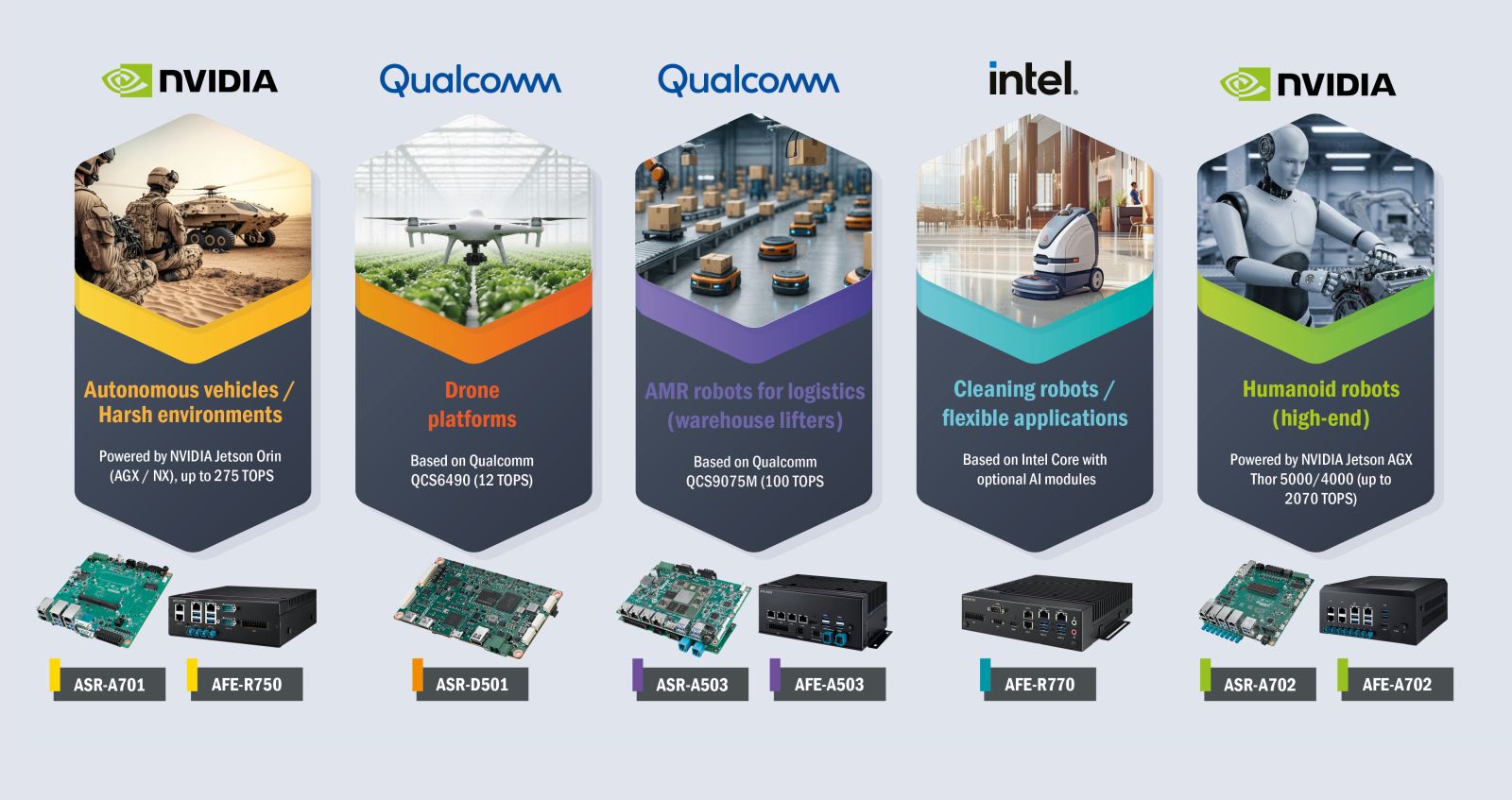
What makes Advantech’s robotics portfolio stand out is that it does not force every robot into the same hardware box. Instead of offering a generic embedded PC, Advantech builds application-focused controllers—each designed for a specific robotic mission.
If you’re developing an off-road autonomous vehicle, ruggedization, strong AI perception, and reliable high-bandwidth connectivity are essential; platforms such as the ASR-A701 \ AFE-R750, powered by NVIDIA Jetson Orin AGX-NX delivering UP TO 275 TOPS, for real-time sensor processing in harsh environments.
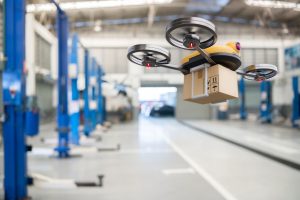
Drones require a completely different balance of weight, size, and power efficiency. The ASR-D501, built around the Qualcomm QCS6490, provides 12 TOPS in a compact footprint optimized for aerial inference.
Warehouse AMR lifters benefit from balanced performance and power efficiency. The ASR-A503/AFE-A503, powered by Qualcomm QCS9075M, delivers 100 TOPS tailored for logistics workflows. Cleaning robots prioritize cost-effective flexibility, where the AFE-R770 combines Intel Core processing with optional AI acceleration modules. Carrier AMRs and AGVs can scale appropriately from Intel Core Ultra to Rockchip RK3588 platforms, ensuring right-sized performance without overdesign.
At the highest tier, humanoid robotics demands full Physical AI capability. The ASR-A702/AFE-A702 powered by NVIDIA Jetson AGX Thor 5000\4000 delivers up to 2070 TOPS, bringing data-center–level AI performance directly into the robot. Jetson AGX Orin configurations provide scalable alternatives for advanced AI applications.
Across the entire portfolio, connectivity is foundational. Advantech Wi-Fi 6E and Wi-Fi 7 M.2 modules ensure seamless fleet coordination and enterprise integration thanks to high-performance and low-latency connectivity.
In essence, Advantech matches the controller to the mission, enabling manufacturers to focus on differentiation and AI innovation rather than hardware compromise.
ADVANTECH TECHNOLOGY PARTNER ECOSYSTEM SUPPORTING MANUFACTURERS FOR RAPID DEVELOPMENT
Advantech’s ecosystem strategy connects silicon providers, sensor manufacturers, and robotics developers to accelerate time-to-market.
Through close collaboration with leading semiconductor partners, Advantech ensures early access to AI acceleration libraries and optimized software stacks. Alliances with major camera, LiDAR, and IMU vendors ensure sensors are pre-validated and driver-supported within the Robotic Suite, providing a cohesive hardware-software pipeline designed specifically for robotics workloads.
This ecosystem-driven model removes friction from sensor integration and reduces development risk. Instead of wrestling with unstable drivers or latency mismatches, manufacturers receive a validated, production-ready framework.
In Europe, Advantech’s engineering center in Munich provides localized design-in services. These include carrier board customization, thermal modeling for extreme environments, mechanical integration support, regulatory assistance for CE marking, and cybersecurity compliance. Robotics System Architect and Ai\Specialist Engineers helping manufacturers transition from lab prototypes to production-ready robotic systems with confidence.
Ultimately, Advantech addresses robot manufacturers’ pain points by removing friction at every layer—compute, thermal design, sensor integration, software stack, connectivity, security, and lifecycle management.
The result is not just a controller, but a foundation that allows robotics companies to focus on what truly differentiates them: intelligent behavior, application innovation, and scalable deployment.