AI-based image processing will improve the competitiveness of many companies from different sectors. It not only opens up new application scenarios and makes creating machine vision applications easier, but is also well suited for rapid prototyping and can thereby accelerate development cycles. Those who have already tested and implemented their first applications are enthusiastic about how quickly good results can be achieved. However, AI vision is not yet being evaluated across the board and planned into new projects.
One factor might be that artificial intelligence for machine vision is not (yet) as intuitive and easy to use as often described. And even if users no longer need to be an image processing professional to perform AI-based image analysis, providing sufficient training data is usually time-consuming and costly. In addition, it requires a certain understanding of how confident conclusions can be generated from them and how these are to be evaluated. In a recent Bitkom survey, every second person stated that they do not use AI in their company for fear of errors in programming and a lack of controllability of AI systems. Only when the user-friendliness of AI is increased and its results, which are difficult to assess, become explainable, will trust in and acceptance of AI vision increase.
 Technology meets user-friendliness
With IDS NXT, IDS Imaging Development Systems has designed such an AI vision ecosystem of hardware and software components, which in addition to machine learning also intuitively maps the complete application workflow. The programmable IDS NXT cameras can process tasks “on device”, thus providing image processing results themselves and can trigger subsequent processes in networked systems directly via REST or OPC-UA. The range of tasks is determined by vision apps that run on the cameras. Their functionality can therefore be changed at any time. Those who use IDS NXT can realise their own AI vision applications quickly and with little prior knowledge of camera programming and Deep Learning and in a time- and cost-saving way. But how does this work exactly?
AI vision in the cloud
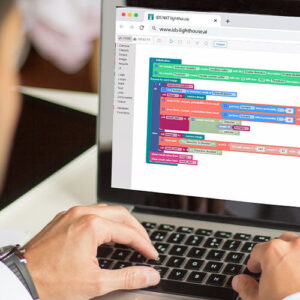
With the AI Vision Studio IDS NXT lighthouse, users can take their first steps with AI, test the suitability of its methods for their applications and also create vision apps for IDS NXT cameras to solve complex tasks. There is no training or setting up a development environment necessary. This makes it easy to get started, which also includes implementation and commissioning of an individual AI vision system. For this purpose, the entire programming is hidden behind easy-to-understand interfaces and tools that cover all steps of an AI vision development. With Amazon (AWS) and Microsoft (Azure), professional cloud computing services are provided that can be adapted to the customer’s requirements. This means that training performance can be increased or new training models can be supported if necessary.
 Providing sufficient data in balanced amounts for all targeted classes is often time-consuming. Since error cases can occur in all possible forms, there is often an imbalance of GOOD and BAD parts. Therefore, it is important to offer solutions that require less training data in preparation. Thus, in addition to classification and object detection, users will in future benefit from anomaly detection, which identifies all known as well as unknown error cases that exceed the normal deviations of a GOOD part. This requires relatively little training data compared to the other AI methods. In other words, anything that would be noticed by a human being who spends a long time learning what objects appear to be “typical” can also be identified by an AI system with anomaly detection. Anomaly detection is thus another useful tool to support quality control by reducing manually performed visual inspections and at the same time detecting and avoiding errors in the production process at an early stage.
Explainable AI
For better understanding a heat map visualisation of the AI attention is provided directly in the AI Vision Studio. For this purpose, special network models are used during training, which generate a kind of heat map during the evaluation of test data sets. It highlights those image areas that receive the most attention from the neural network and therefore influence the results and performance. Incorrect or under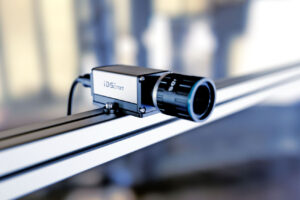 representative training images can also sensitise the AI to unwanted features. Even an accidentally trained product label can falsify the results. The cause of such “wrong” training is called data bias. These attention maps help to reduce concerns about AI-based decisions and to increase acceptance in the industrial environment.
Outlook
IDS is constantly developing its AI system with a special focus on user-friendliness and time efficiency. This will enable AI to be used more quickly across the board, including SMEs. On the hardware side, the IDS NXT camera family is also being extended by an even more powerful hardware platform that can execute neural networks much faster. This enables AI vision even in applications with high clock rates. However, what helps most in expanding AI vision are companies that have already implemented successful AI vision projects and can tell others about them.