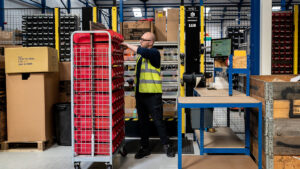
 How do warehouse operatives work with the likes of warehouse automation? And what does that look like in an everyday picking scenario?
There’s a great deal of discussion around the role that warehouse operations play in an automated warehouse and it’s potential for a positive impact. There’s talk of improved working conditions, increased opportunities, and overall improved efficiencies.
But what does that really look like in an everyday picking operation?
Here’s a detailed walk through of what some warehouse operatives already do in a goods-to-person robotic environment, powered by an integration with Wise Robotics.
 Workstation software
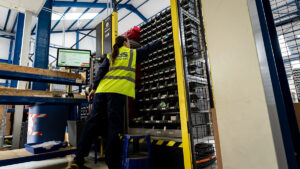
Each shift, operatives sign into their station with a unique login. Users can be set up with individual permission settings to control access to various areas of the system. Upon signing into their workstation, pickers are presented with a simple screen that shows what needs to be picked and from which rack. For the operative, it’s a simple case of being presented with the relevant bin number and the quantity of items required – all made even easier with the aid of picking spotlights.
Pick-to-light system
When a robot carries a freestanding shelf rack to a picking station, integrating pick-to-light technology means you can have a spotlight and camera mounted on top of your stations. This camera allows the rack shelves to be scanned with machine vision and the light then swivels to shine a light on the section that needs to be picked from.
One touch picking
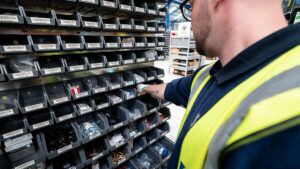
From here, the picker scans the item, prints the label if required, and places the item in a tote ready to be taken to the next stage of the process. It really can be as simple as that.
 A way of working that’s tailored to you
No warehouse operation is the same. That’s why warehouse automation is a perfect solution for the businesses seeking a custom solution. Using the data already running through your business, rules and workflows can be defined to make your robotic solution work exactly the way you need it to. Whether it’s how the software should operate during peak seasons, how your different orders are prioritised, or how the robots interact with different workstations – it’s all down to you.
Protecting your operatives
Using laser detection, ultrasonic pulses, and machine vision augmented camera feeds, the robots can accurately distinguish between inanimate obstacles, staff, and picking stations.
As well as being surrounded by safety features, your workers aren’t risking strains or injuries from all the repetitive bending, moving, and lifting that come with warehouse work. Instead, they can take on more engaging, value-added positions that pose less risk of injury.
Utilising your new data set
Time stamps of every interaction your operative might encounter are recorded – including rack arrival, rack departure, first scan, last scan etc. It also collects timing data for every user, down to the individual task. So, well as allowing in-depth reporting on performance, customer complaints can also be examined downed to the finest detail.
 Give your team a warehouse to be proud of
Managing a warehouse isn’t easy – especially through ongoing labour challenges. Warehouse automation is of course a tool that can directly combat a lack of workers, but it’s also a tool that can empower and attract future staff.
Workers demand more, and warehouse automation is there to provide it. Whether that’s providing a more appealing working environment or providing more opportunities for growth – you’re giving your workforce the tools of the future.
To discover more about the role of your workforce in an automated warehouse, watch a video of workers in action here.
Joe Daft, Head of Robotics at Wise Robotics
joe.daft@wiserobotics.com