As CNC machining centres continue to evolve, machine builders are under increasing pressure to deliver higher productivity, greater reliability and enhanced process visibility. At the heart of many modern machining centres, automatic tool-changing spindles play a critical role, enabling rapid switching between cutting tools optimised for different materials, workpieces and machining operations.
Ensuring that every tool change is completed correctly is essential. Even a minor deviation in drawbar position can result in incomplete tool engagement, leading to tool damage, compromised part quality, machine downtime and potentially costly spindle repairs. For decades, monitoring these critical positions has relied on multiple discrete sensors, creating complexity in both machine design and installation.
Contrinex’s new Travel Sensor offers a more intelligent approach, combining high-precision position measurement, digital configuration and IO-Link communication in a single compact device.
The Importance of Accurate Drawbar Monitoring
Within an automatic tool-changing spindle, a spring-loaded collet retains the cutting tool in position. The collet is actuated by a central drawbar running through the length of the spindle. During a tool change sequence, an actuator moves the drawbar along its axis, releasing the current tool before allowing a replacement tool to be clamped securely.
For the process to operate reliably, machine control systems must be able to verify several critical drawbar positions, typically:
- Open – ready for tool loading or removal
- Armed and Locked – tool securely clamped and ready for machining
- Closed Without Tool – spindle closed but no tool present
Failure to accurately detect these positions can have significant consequences. If a collet fails to retract fully or a tool does not engage correctly, machining may commence with an improperly secured tool. The resulting damage can affect the tool, the workpiece and, in extreme cases, the spindle itself.
As spindle assemblies become increasingly compact, manufacturers require robust and fail-safe monitoring solutions that can be integrated without increasing system complexity.
Limitations of Conventional Sensor Arrangements
Traditionally, the three operating states of a spindle drawbar are monitored using three separate switching sensors positioned at different locations within the spindle assembly.
While functional, this approach presents several challenges:
- Increased component count
- Additional wiring and installation effort
- Mechanical alignment and adjustment requirements
- Larger installation footprint
- Increased commissioning time
- Higher overall system cost
For machine builders, each additional component represents both a design consideration and a potential point of failure. In high-performance machining applications where reliability and repeatability are paramount, simplifying the sensing architecture can deliver significant operational benefits.
One Sensor, Complete Positional Control
The new Contrinex Travel Sensor has been developed to replace traditional multi-sensor arrangements with a single intelligent sensing device that monitors the full drawbar movement range.
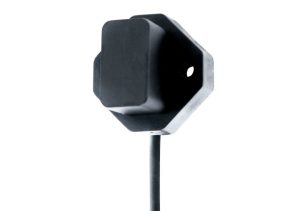
Installed radially within the spindle body, adjacent to the drawbar, the embeddable 15 x 25mm sensor serves as a high-precision distance-measurement device. Its target is an inclined surface machined onto the circumference of the drawbar. As the drawbar moves, the distance between the sensor and the target changes proportionally, allowing the sensor to determine the exact drawbar position in real time.
With a sensing range of up to 20 mm, the sensor provides highly accurate 16-bit digital measurement data. This enables continuous monitoring of drawbar travel, rather than simple on/off position detection, giving machine builders access to significantly richer process information.
Digital Configuration Eliminates Mechanical Adjustment
One of the key advantages of the Travel Sensor is its ability to digitally define multiple switching points.
During commissioning, the drawbar positions corresponding to the required operating states are recorded within the sensor. Users can then configure up to three switching points to represent:
- Open position
- Armed and locked position
- Closed without tool position
By replacing mechanical sensor adjustment with digital teaching, installation becomes faster, more repeatable and less dependent on manual fine-tuning. The approach also reduces setup time for OEMs while simplifying future maintenance and replacement procedures.
Configuration is performed using Contrinex’s PocketCodr tool, enabling rapid parameterisation and straightforward commissioning..
Real-Time Monitoring and Enhanced Machine Protection
Beyond simple position detection, the Travel Sensor continuously monitors drawbar movement throughout the entire tool-change cycle.
During operation, the machine control system can verify that the drawbar follows the expected motion profile. Once the programmed end position is reached, the sensor can trigger the next step in the sequence, helping optimise tool-change efficiency.
If a measurement falls outside acceptable limits, the control system can immediately halt the process and raise an alarm. This proactive approach helps prevent costly crashes, protect spindle components, and reduce the risk of producing defective parts.
The ability to continuously monitor movement, rather than simply detect end positions, represents a significant advancement in spindle condition monitoring and process security.
Designed for Industry 4.0 Environments
Like all devices within the Contrinex Smart Sensor portfolio, the Travel Sensor incorporates integrated IO-Link connectivity as standard.
This provides machine builders and end users with a number of benefits, including:
- Simplified integration into machine control systems
- Remote parameter configuration
- Enhanced diagnostics
- Access to real-time process data
- Support for predictive maintenance strategies
On-board data storage enables the collection of cumulative operating data, allowing users to monitor trends, identify emerging issues, and schedule maintenance activities more effectively.
Benefits for OEMs and End Users
By replacing three conventional sensors with a single digitally configurable device, the Travel Sensor delivers several tangible advantages:
- Reduced installation and commissioning time
- Lower component and wiring costs
- Simplified machine design
- Improved reliability and repeatability
- Enhanced diagnostics and process transparency
- Easier integration into compact spindle assemblies
- Support for predictive maintenance initiatives
For OEMs, this translates into a more streamlined machine design and lower build costs. For end users, the result is improved uptime, enhanced process reliability and greater confidence in tool-change performance.
A Smarter Approach to Tool Change Monitoring
As machine builders pursue ever higher levels of productivity and automation, sensing technology must provide more than simple switching functionality. Intelligent devices capable of delivering precise measurement, advanced diagnostics and seamless digital integration are becoming increasingly important.
Contrinex’s new Travel Sensor addresses these requirements by combining high-resolution position measurement, configurable switching functions and Industry 4.0 connectivity within a single compact package. By simplifying spindle drawbar monitoring while enhancing performance and reliability, it offers machine tool manufacturers a modern alternative to traditional multi-sensor solutions and a smarter approach to safeguarding every tool change.
Contrinex’s UK distributor, PLUS Automation, holds over 2,000 parts in stock in the UK and prides itself on working with engineers to determine the best sensor solution. It invites people to call them on 0121 58 222 58 and ask how to #MakeSenseofSensors or how to #MakeSenseofSafety.