 Over the last three years, a team of engineers and apprentices at Schaeffler UK’s manufacturing plant in Llanelli, South Wales, has successfully implemented a range of new automation systems across the plant.
These systems have helped to improve the efficiency of individual machines and complete production lines, as well as helping to reduce manual handling, remove bottlenecks from production, and to reduce manufacturing throughput times.
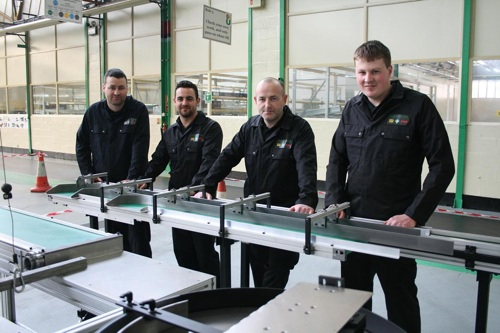
Interestingly, the team itself comprises three engineers, all of who began their careers at Llanelli on the apprenticeship scheme. The team, which was established in 2010, possesses a blend of engineering skills and experience to help tackle every type of automation project that the plant requires.
Amazingly, the team also boasts a combined experience of 57 years at Llanelli. Darran Williams (automation technician and team leader) has worked at the plant for 25 years, Mark Williams (CNC machining specialist) for 17 years and Grant Nicholas (fabrication specialist) for 15 years. Darran and Mark have been part of the automation team from the beginning, with Grant joining two years ago. Periodically, the team receives extra help from its own pool of apprentices – this year Daniel Summers, a tool room apprentice in his fourth year of the apprenticeship, has been helping out. At other times, apprentices from maintenance or production may be asked to help.
The production environment is fast paced and highly automated. In the last two years, the company has invested several million Euros in new surface coating technology for tappets, as well as a 66 tonne deep drawing press, which enables the plant to produce highly repeatable, superior quality tappets for automotive OEMs.
The automation projects at Llanelli therefore, vary in size and duration, from small, one week projects to larger projects that can last for several months. Examples include the design and implementation of new conveyor systems, parts transfer and feed-in systems for various types of machinery, including CNC machines, heat treatment furnaces, presses and washing stations. The projects themselves typically arise from Continuous Improvement or Kaizen initiatives, where specific production problems need resolving.
As Darran Williams explained, “The automation projects team requires many different skills: electrical, mechanical, hydraulics and pneumatics, fabrication, machining, welding and tool making. We also need people who can work in a team and who can look at a problem and then go away and find the most appropriate solution. For current apprentices such as Daniel [Summers], this kind of project experience is invaluable and has helped to develop his tool making and problem solving skills.”
This move towards using standard, automation components has helped to support new machine optimisation projects, where groups of CNC machines have been ‘linked’ via a single feed-in conveyor system. This has helped to ‘synchronise’ production and improve plant throughput.