 EtherCAT has seen strong global use for more than 10 years, and accordingly, the EtherCAT Technology Group (ETG) has indeed grown into a global organisation. A new milestone – not only for the ETG, but for the technology itself – has been achieved: EtherCAT is now a national technology standard in China. On October 21st, Dr. Wei Sun, representative of the Standardisation Administration of China (SAC), made the announcement at a ceremony in Beijing.
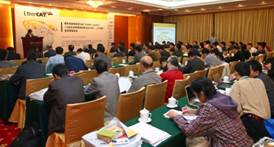
Hosted by ITEI president, Prof. Jinsong Ouyang, the event brought together numerous experts from a wide range of industries in the official guest house of the Chinese government. There, SAC director, Dr. Wei Sun announced EtherCAT as National Standard GB/T 31230 in China.
As a special highlight, Chinese company representatives shared experiences with their numerous EtherCAT systems and applications with the audience and explained the benefits realised through implementation. When Yunying Huang, vice president of Shenyang Machine Tool R&D Institute Shanghai, introduced the company’s new, intelligent i5 CNC machine tool entirely based on EtherCAT, he emphasised that performance, openness, and the large product selection available from many of the world’s largest vendors were the main decisive factors for selecting EtherCAT. Dr. Frank de Schepper, CEO of Wenzhou-headquartered SIBONAC Laser Technologies, which is also heavily involved in CNC applications, reported the benefits of EtherCAT for his company: “The EtherCAT protocol is open, easier to use, and faster than alterntive protocols.”
In addition, Prof. Ji Huan from Beihang University explained from a research point of view how CNC machines benefit from EtherCAT. Huan stated: “Besides the performance, I see the main advantage of EtherCAT for Chinese users and implementers alike being the excellent support that the technology enjoys in China. Training classes and workshops, sample code, documentation, and implementation support, as well as test and certification services, are readily available.” In close cooperation with ITEI, several ETG member companies from China, as well as the local EtherCAT Competence Center at Beihang University in Beijing, contributed significantly to the completion of the standard.
The worldwide adoption of EtherCAT, especially in China, was clearly demonstrated in the presentations of Martin Rostan, executive director of the EtherCAT Technology Group, as well as Beryl Fan, manager of the ETG China office in Beijing. “With over 400 local members, the ETG has grown tremendously in China, particularly over the past few years. Acceptance as a Chinese National Standard is a significant milestone for our organisation. With this development it will now be even easier for end users, manufacturers, and vendors to understand, implement, and use EtherCAT in the future,” explained Fan.
Rostan added: “China is growing into the world’s largest automation market, and we are pleased to see the high adoption rate of EtherCAT within this market in all kinds of applications, from machine controls, power generation and distribution, to mobile applications, scientific systems, and beyond. Becoming a recommended national standard in China will further boost the success of EtherCAT, providing even more local language access to the technology and ensuring acceptance in all publicly-funded projects.”
The ceremony closed with live demonstrations of various EtherCAT systems featuring Chinese and international EtherCAT products.