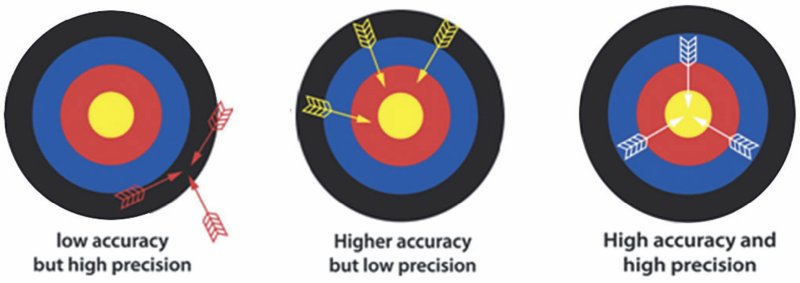
 Despite their frequent use, the terms accuracy, resolution and repeatability are often misunderstood. As critical factors in the selection of position and speed sensors, engineers must ensure they fully understand the terminology, says Mark Howard, General Manager at Zettlex
The terminology applied to instrumentation can be confusing but is critical when it comes to selecting the right measuring instruments for an application – especially for position and speed transducers. Get this part wrong and engineers could end up paying more than they need to for sensors or a product or control system may lack critical performance.
Definitions:
• An instrument’s accuracy is a measure of its output’s veracity.
• An instrument’s resolution is a measure of the smallest increment or decrement in position that it can measure.
• A position measuring instrument’s precision is its degree of reproducibility.
• A position measuring instrument’s linearity is a measurement of the deviation between a transducer’s actual output to the perfect slope of displacement versus output.
Most engineers get confused about the differences between precision and accuracy. Using the analogy of an arrow fired at a target, accuracy describes the closeness of an arrow to the bullseye. If many arrows are fired, precision equates to the size of the arrow cluster. If all arrows are grouped together, the cluster is considered precise.
A perfectly linear measuring device is also perfectly accurate. So, that’s pretty straightforward then – as long as you specify very accurate and very precise measuring instruments every time, you’ll be okay. Unfortunately, there are snags to this approach. First, high accuracy, high precision instrumentation is always expensive. Second, high accuracy, high precision instrumentation may require careful installation and this may not be possible due to vibration, thermal expansion/contraction. Third, certain types of high accuracy, high precision instrumentation are also delicate and will suffer malfunction or failure if there are changes in environmental conditions – most notably temperature, dirt, humidity and condensation.
The optimal strategy is to specify what is required – nothing more, nothing less. In a displacement transducer in an industrial flow meter for example, linearity will not be a key requirement because it is likely the fluid’s flow characteristics will be non-linear. More likely, repeatability and stability over varying environmental conditions are the key requirements.
In a CNC machine tool, it is likely accuracy and precision will be key. Therefore, a displacement measuring instrument with high accuracy (linearity), resolution and high repeatability even in dirty, wet environments over long periods without maintenance, are key requirements.
Always to read the small print of any measuring instrument’s specification – especially about how accuracy and precision and linearity varies. If this variation is monotonic and slowly varying, the non-linearity could be easily calibrated out using a few reference points.
Optical encoders
Optical encoders work by shining a light source onto or through an optical element – usually a glass disk. The light is either blocked or passes through the disk’s gratings and a signal, analogous to position, is generated.
The glass disks have tiny features that allow manufacturers to claim high precision. What is often not explicit is what happens if these tiny features are obscured by dust, dirt or grease. In reality, even very small amounts of foreign matter can cause mis-reads. Less well known is the issue of accuracy in optical encoders and optical encoder kits.
Consider an optical device using a 1-inch nominal disk with a resolution of 18bits (256k points). Typically, the claimed accuracy for such a device might be +/-10 arc-seconds. However, the stated accuracy assumes the disk rotates perfectly relative to the read head and that temperature is constant.
If we consider a more realistic example, the disk is mounted slightly eccentrically by 0.001-inch (0.025mm).
A perfectly mounted optical disk requires such fine engineering that cost becomes prohibitive. In reality, there is a measurement error because the optical disk is not where the read head thinks it is. If we consider a mounting error of say 0.001-inch, the measurement error is equivalent to the angle subtended by 0.001-inch at the optical track radius. To make the maths easy, let’s assume that the tracks are at a radius of 0.5-inch. This equates to an error of two milliradians or 412 arc-seconds. In other words, the device with a specification accuracy of 10 arc-seconds is more than 40 times less accurate than its data sheet.
If you get an optical disk to position accurately to within 0.001 of an inch you are doing really well. Realistically, you’re more likely to be in the range 2-10 thousandths of an inch, so the actual accuracy will be 80-400 times worse than you might have originally calculated.
The measurement principle of a resolver or a new generation inductive device is completely different. Measurement is based on the mutual inductance between the rotor (the disk) and the stator (reader). Rather than calculating position from readings taken at a point, measurements are generated over the full face of both the stator and rotor. Consequently, discrepancies caused by non-concentricity in one part of the device are negated by opposing effects at the opposite part of the device. The headline figures of resolution and accuracy are often not as impressive as those for optical encoders. However, what’s important here is that this measurement performance is maintained across a range of non-ideal conditions.
The quoted measurement performance of some of the new generation inductive devices are not based on perfect alignment of rotor and stator but realistically achievable tolerances (typically +/-0.2mm) are accounted for in any quoted resolutions, repeatabilities and accuracies. Furthermore, stated performance for inductive devices are not subject to variation due to foreign matter, humidity, lifetime, bearing wear or vibration.
Zettlex
T: 01223 874444