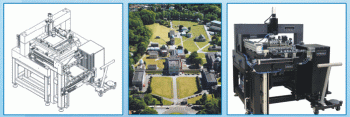
 The DAMIAN ultra-precision scanning system at the Royal Observatory of Belgium (ROB) fulfils a significant part of a global programme for the digitisation of astrometric plates and aerial photographic images that span over a century and has shaped our understanding of the world, the solar system and the universe.
The ROB began development of the DAMIAN (Digital Access to Metric Images Archives Network) digitiser with a study that produced design specifications for a 350mm x 350mm X-Y scanning motion system. For extreme precision and dynamic performance, the ROB chose Aerotech for a complete motion sub-system based upon its ABL3600 series open-frame air bearing table in a custom-engineered system solution.
Aerotech’s ABL3600 series X-Y stage includes a preloaded, high-stiffness air bearing system featuring powerful dual brushless and slotless linear motors on each axis with glass scale linear encoder servo feedback. Two granite rails form a reference for the lower axis and both axes are referenced to a lapped granite surface plate with passive air isolation to maximise vibration stability. Aerotech’s linear technology servo amplifiers are said to guarantee exceptionally smooth motion, high bandwidth and outstanding in-position stability with zero backlash or hysterisis. The friction free mechanics are also said to provide an essentially limitless, maintenance-free working life. The large through aperture of the open frame design allows back illumination for the plates and images.
The design of the ABL3600 has a pedigree of successful applications in semiconductor fabrication and test and suits demanding scanning microscopy, imaging and step and repeat positioning applications.
For the ROB, Aerotech extended the ABL3600’s normal working travel range from 250mm to 350mm in both axes. Aerotech’s HALAR calibration ensures optimal levels of accuracy, bi-directional repeatability, straightness and flatness for each axis then performs error mapping with laser based measurement systems at Aerotech’s metrology lab – with the calibration file pre-configured on the motion controller. During tests, object locations on a calibrated test plate were repeated to within 70 nanometres over a usable X-Y travel range of 335mm. Other results included geometric tests for accuracy and repeatability to better than +/- 0.1 micron.