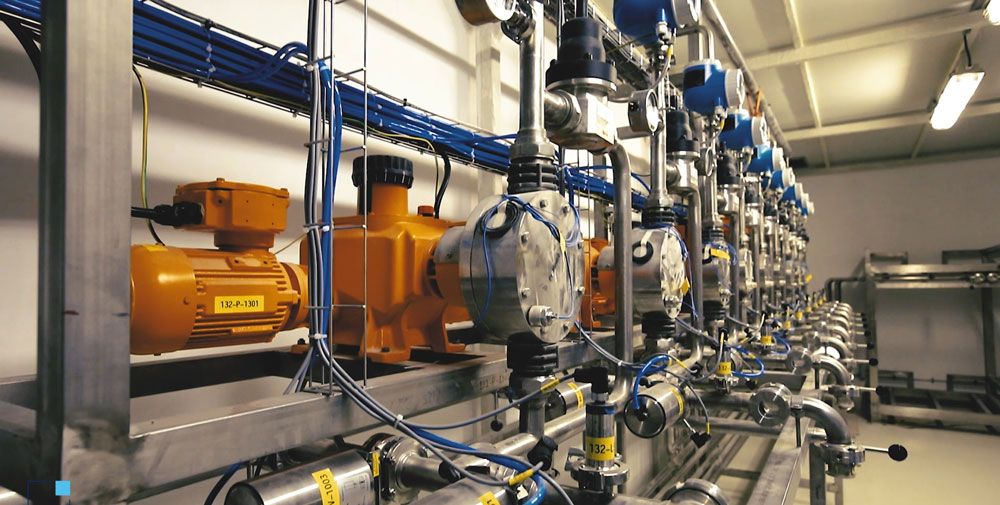
When a major chemical producer set out to modernise its liquid processing facility the objectives were ambitious and industry-shifting: 0…run production around the clock, with automated control across 11 mixers, multiple chemical preparation stations, and a full tank farm—without increasing headcount.
RAP Systems was selected to deliver the full automation layer, including PLC logic, HMI design, network configuration, and recipe-driven batch control. The result is a plant that now runs hands-off for most of its operation, with operators stepping in only for changeovers and material replenishment.
A Plant Built on Smart Software, Not Manual Work
Instead of traditional standalone mixer controls, RAP Systems implemented a single, connected automation program that manages:
- 83 motors
- 647 valves
- 98 proportional controls
- 240 analog measurements
- 11 recipe systems
- Over 50 raw and finished product tanks
Every mixer shares the same software foundation—so once a recipe is tested on one vessel, it can be duplicated to others instantly.
No reprogramming. No operator rewriting steps. Just “select recipe and run.”
“It allowed the plant to scale complexity without scaling labour. That was the key win.”
— Lead Controls Engineer, RAP Systems


Designed for Real Production, Not Lab Conditions
This isn’t a system designed in isolation—the project is running live, 24/7, producing chemical formulations at industrial volume. Key design features that support that reliability include:
- Automatic interlocks based on level, temperature and flow
- Safe shutdown on high-level events or air/electrical loss
- Restart logic that recovers running batches without data loss
- Online trending and historian for both operators and QA teams
Even dosing isn’t treated as a simple valve open/close—agitation speed and heating profiles are configured as actual recipe ingredients, giving process engineers far more control.


Operators Don’t Just Run the System—They Command It
A central HMI server allows up to 20 connected operator stations, each with different access:

It feels less like controlling equipment, and more like overseeing a command centre.
Screens include:
- Mixer dashboards
- Tank farm and barrel handling
- Raw material intake
- Batch trends (live + historical)
- Alarm banner + history
- Recipe creation + simulation mode
A simulation screen lets engineers test recipes offline, reducing waste and approval time.


A System Built to Grow
RAP Systems deliberately engineered spare memory, spare I/O, and standardised templates so the plant can expand without software rewrites. New equipment can be added in hours rather than months.
“Every valve, pump, and sensor follows the same logic template—so the plant grows like Lego, not a rewiring project.”

Tested Like an Aircraft, Not a Factory Machine
Before going live, the plant underwent:
▶ 4-Hour Full Automatic Dry-Run
▶ Simulated power + air failures
▶ Emergency-stop recovery
▶ Production restart without batch loss
Ten forced fault conditions were triggered during commissioning, and the system restarted correctly after each one—proving resilience before real product ever entered the lines.

This isn’t just automation—it’s a foundation for future autonomous manufacturing.

Final Takeaway
This project demonstrates how industrial automation can move beyond just controlling machines—and instead orchestrate entire chemical processes with precision, efficiency, and scalability.
RAP Systems delivered not just a functioning control system, but a production environment engineered for growth, reliability, and true lights-out manufacturing.
 RAP Systems Contact Details:
systems.office@rap-group.ro
www.rap-systems.ro
Silviu Cucuian Contact details:
+40 723 35 09 82
silviu.cucuian@rap-group