Designing machine safety systems is no longer just about meeting regulatory thresholds. The real pressure lies in achieving those requirements while keeping installations compact, cost-effective and straightforward to engineer. ReeR Safety’s MOSAIC M1 was developed with exactly this challenge in mind. It serves as the core controller for a modular, expandable safety platform that manages complex architectures with large numbers of devices and relays.
Where traditional relay-based solutions rely heavily on discrete hardware, MOSAIC M1 shifts much of the complexity into software. The result is a leaner system architecture with fewer components, greater flexibility, and a much easier path for future modifications.
A Compact Controller for Demanding Safety Architectures
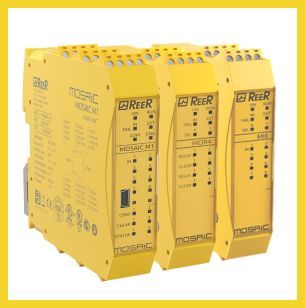
MOSAIC M1 is the standard main module within the MOSAIC platform. It can operate as a standalone controller for smaller machines or serve as the master unit in larger, distributed safety systems via expansion modules.
Key features include:
- 8 digital inputs for safety sensors
- 2 dedicated inputs for restart and EDM
- 2 pairs of OSSD safety outputs (PNP, 400 mA)
- 2 configurable status outputs (PNP, 100 mA)
- 4 test outputs for short‑circuit monitoring
- Field‑bus interface for MOSAIC expansion modules
By consolidating functions that would otherwise require multiple relay modules, the M1 significantly reduces the electrical panel footprint.
Reducing Panel Space, Increasing Design Flexibility
One of the most immediate advantages of MOSAIC M1 is the reduction in panel space. Traditional architectures often demand numerous relays, extensive wiring and additional power supplies to manage multiple safety functions. MOSAIC dramatically reduces hardware overhead, simplifies wiring, and shortens build time.
This is particularly valuable in systems where a high number of safety relays must be controlled and where panel space is already at a premium.
Software‑Driven Configuration Without the Complexity
Configuration is handled through Mosaic Safety Designer (MSD), a free software tool that minimises errors, improves traceability, and automatically calculates key performance parameters (PFHd, DCavg, MTTFd) in line with ISO EN 13849‑- 1 and EN 62061.
The graphical interface enables engineers to:
- Define safety logic intuitively
- Modify projects easily, even late in development
- Simulate and validate logic behaviour
- Monitor system status in real time during commissioning
Case Study: Narita Techno and Hydrogen Furnace Safety
Narita Techno, a specialist in industrial furnaces and gas burners, provides a clear example of the platform’s value. One of its most demanding applications involves hydrogen-fuelled industrial furnaces, where safety is critical due to the high flame speed and the associated risk of backfire. To mitigate this, pipework must be purged with nitrogen before ignition.
A traditional hardware‑only approach would have required up to 16 safety relays per burner and with the associated complexity and maintenance requirements.

Instead, Narita Techno deployed MOSAIC M1 as the master controller, supported by the MI8 input module and the MOR4 safety relay output module. The MI8 adds eight digital safety inputs, enabling extensive sensor integration without additional controllers. The MOR4 provides configurable relay outputs with options for single or dual‑channel operation and EDM feedback.
This combination allowed Narita Techno to build a sophisticated safety system within a compact panel layout. A relay‑based equivalent would have required far more components, more wiring and a higher risk of installation errors.
The MOSAIC‑based solution enabled Narita Techno to:
- Reduce panel space through modular expansion
- Streamline design and validation via software
- Manage numerous safety I/O points with minimal hardware
- Meet the requirements of Japanese standard JIS B8415
- Lower costs compared with safety PLC‑based alternatives
The installation, completed on a hydrogen furnace in Tokoname, demonstrates the platform’s suitability for high‑risk, high‑complexity environments.

A Scalable Architecture for Repeatable Designs
Beyond the technical achievement, the Narita Techno project highlights a key advantage of the MOSAIC architecture: repeatability. With traditional relays, each burner would require up to 16 dedicated modules. In multi-burner systems, this results in linear—and ultimately unsustainable—growth in components and wiring.
MOSAIC avoids this by centralising logic in the M1 and extending functionality through MI8 and MOR4 modules. Adding a new burner or station becomes a matter of extending the existing architecture rather than redesigning it.
This makes the platform particularly attractive for manufacturers of series-built machinery, modular plants and multi-station systems, where standardised safety designs and easy replication can deliver a genuine competitive edge.
Call PLUS Automation on 0121 58 222 58 or email Sales@PLUSAx.co.uk to discuss how they can help you #MakeSenseofSensors using Inductive, Machine Safety, Photoelectric, Pressure, Process, RFID and Ultrasonic sensors from CONTRINEX, ReeR & SATRON.
With over 2,000 sensors in stock in the UK, supported by stock held in Europe and short manufacturing lead times, PLUS Automation welcomes the opportunity to discuss improving automation and machine performance or reducing costs.