 Accurate tracking of high-value, costly items through a production process is becoming an increasingly common requirement. Luxury cars, for example, are supplied to specific customer preferences such as optional equipment, colour and trim. But what may be a salesman’s dream can be a production manager’s nightmare. Tracking each vehicle to deliver exactly the right customer choices means knowing, in real time, the exact specification of each individual vehicle and the stage it has reached in the production process, says Tim Stokes, Auto-Ident product specialist, Sick UK
Tracking errors are the gremlins that can undermine the logistics of a bespoke manufacturing operation. For car manufacturers who are compelled by marketing pressure to offer many choices to attract customers, it can be months or years before the same combination is requested again, so a wrongly kitted-out car could be an expensive mistake.
Attaching a unique identifier early in manufacture, such as during installation of the floorpan, is therefore essential to avoid identification mix-ups.
Intelligent read/write for life
RFID systems, with transponders on the workpiece and read/write interrogators at the appropriate points in the product flow, offer many advantages in complex manufacture and assembly. The transponders are capable of holding large amounts of information which can be added at each stage.
The information stored provides traceability and quality assurance data, details the exact processes undergone and the components added to meet the required final specification. The data can even remain attached and accessible throughout the vehicle’s lifetime for full accessibility, even aiding eventual recycling.
Although more expensive per item, RFID is said to be more reliable than 1D/2D barcoding and part-marking systems which are frequently obscured by dirt, paint or tape, damage and lack of line-of-sight visibility.
Beating adverse conditions
But the ‘Achilles heel’ of RFID has traditionally been its tendency to become inaccurate in locations with extensive metal surfaces and mass, or volumes of fluids, which may distort and reflect the radio signal.
Of course, these potential barriers are present in many manufacturing environments. So manufacturers are keen to find ways around them –
especially those with high-value products with a large number of components and product variants. One customer of Sick, a prestige automotive manufacturer at a production plant in Germany, was experiencing difficulties with consistency of operation through the paint shop.
Use of standard RFID had resulted in frequent line downtime from null reads, as well as some specification errors when the wrong car was selected. There had even been collisions where a car body became ‘invisible’. As a result, some cars had to be rejected. Paper label identification did not survive the paintshop drying process, and attempts to use RFID after the paint shop, combined with additional barcoding, had also not delivered the accuracy needed for efficient manufacturing operations.
Virtual 100 per cent accuracy
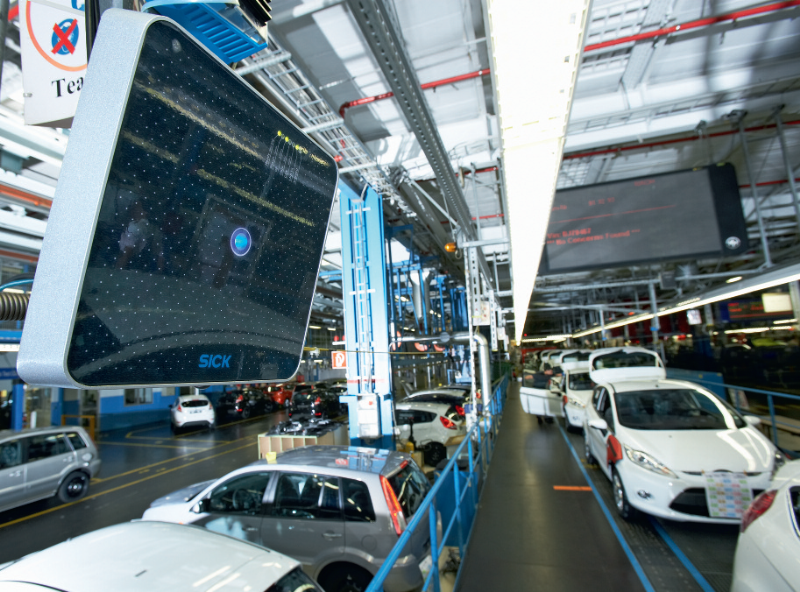
The Sick engineering team was called in and recommended new Sick RFU630 UHF read/write interrogators, which were installed at 24 points in the paint shop. These rugged and compact devices were required to operate under very unfriendly conditions including metal walls, ceiling and floor, heavy metal machinery such as the conveyor, other car bodies and a temperature of up to 1,800C.
Reader location was important. For instance, by ensuring that the actual reading point was located where the car body stopped briefly before it entered the drying kiln, optimum transmission conditions were obtained. To match the RFID device, a rugged and long-life UHF transponder tag developed by Sick especially for the automotive industry was attached to each car body, designed to withstand conditions inside the kilns of 2,300C. Despite the ‘high noise’ metal environment, the RFID system was found to operate with better than 99.98 per cent accuracy over approximately 350,000 scans a day.
Following the paint drying, the bodies are loaded in any order onto a skid conveyor section for the next processing stages, such as seam sealing by robot. As these processes proceed down three parallel lines and on to the complexities of engine and interior fit out, accuracy of the individual on-vehicle records is crucial. With the transponder, the on-car records are always available to the manufacturer, at any stage of the vehicles life.
Versatile and widely compatible
The RFU630 is able to accommodate up to three external aerials, and has a reading range of between 0.4 and 1.2m, delivering excellent coverage. Operating on the Sick IDpro platform, it is easily integrated with a wide range of SCADA/Ethernet systems, as well operating easily with other Sick ident technologies such as 1D/2D barcodes for a factory-wide automated ident system. Configuration is very simple using the Sick SOPAS tool with its auto-ID function, and as well as application specific software, freely definable outputs, for example operating actuators, can be incorporated.
Sick (UK)
T: 01727 831121