 One-cable feedback technology has been rapidly adopted and incorporated into servo motors and drives by manufacturers keen to capitalise on its benefits. Automation asked SICK’s UK product manager, Darren Pratt to outline the technology and why it is important.
There’s little doubt that Hiperface DSL (Digital-Servo-Link) technology has been revolutionary. When launched in 2011, the interface made a single cable servomotor a reliable proposition for the first time.
Now tried, tested and field proven in applications all over the world, Hiperface DSL from SICK is widely recognised as an industry standard in one cable technology and a leading standard protocol for digital feedback systems. This digital interface also meets all the requirements for the condition-oriented maintenance of machines in an Industry 4.0 environment.
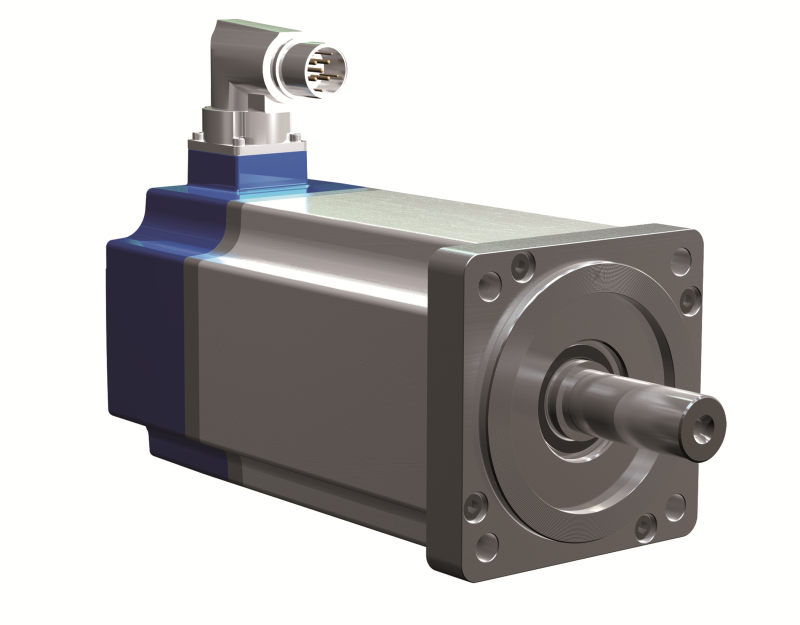
Hiperface DSL has opened up opportunities for machine builders to develop more compact, efficient and reliable machines, as motor and drive suppliers have accelerated integration of into their product development. So much so, that it has been rapidly integrated into the products of more than 40 major servo drive and motor manufacturers including many major brand names such as ABB, Beckhoff and WEG. Electric drives featuring motor feedback systems and an integrated Hiperface DSL interface have a distinctive outward appearance with just one motor connector.
Now, in the next stage of its development, SICK is opening up the Hiperface DSL interface for use by any drive or motor manufacturer, a move which will make it an open market standard.
With the security of an open and field-proven interface, it seems likely the industry will see yet more extensive machine development and innovation and, in future, the interfaces needed to support servo drives will be minimised.
What is one cable technology?
Encoders are fundamental to the operation and control of a servo motor axis, delivering high-resolution feedback about the angular rotation for speed regulation and positioning the servo axis precisely through multiple revolutions. Analogue communication with the encoder can typically require an eight, ten, twelve or even 14-core data feedback cable. In addition, a power cable which also incorporates twin cores for temperature sensing is also needed. The cabling is bulky, taking up valuable machinery and control cabinet space.
Hiperface DSL enables reliable data transfer between drive and motor via two wires which are directly integrated into the motor cable of up to 100m in length. The Hiperface DSL digital interface is so robust that the twisted pair, traditionally used for the temperature winding sensor in the cores of a standard motor power cable, can be used for the communication of feedback data to the drive. This therefore makes the bulky, multi-core feedback cable redundant.
SICK UK
T: 01727 831121