Subtractive metal manufacturing involves machining the finished component from a solid piece of material, therefore a lot of unused material is usually left behind, as waste. Some of this can be recycled and reused, though the cost of waste to the manufacturer remains. Such costs are absorbed within the production process, thus product price, that is then passed to the consumer.
In plastics manufacturing, however, the volumes of materials that have to be disposed of are higher, usually owing to the brittle nature of plastic, that can chip and crack when machined. Thin components or items with sharp corners have an increased likelihood of chipping, cracking or shattering completely and must be machined more slowly. An appropriate cutter tool selection can help alleviate this issue – the only challenge is the cost of tooling and reduced turnaround time – output volumes are reduced and cost per item therefore increases.
In considering both subtractive metal manufacturing and machining with plastic, a recent uptake in the utilisation of 3D printing, otherwise known as additive manufacturing, is providing manufacturers with an alternative means to produce products, with low failures and reduced raw material wastage.
The 3D printing revolution might have started at the desk top: 3D printers designed to accommodate small build, low volumes, but the delivery of 3D printing processes has accelerated in recent months as developers of large scale, high volume 3D printing methods push the boundaries of modern manufacturing, utilising generative software, industrial robots and extruders, capable of laying down all manner of materials, such as metals, polymers and even concrete, delivering additive manufacturing capabilities into a plethora of industries.
One typically cost-heavy, pre-mass production consideration, is prototyping. This is an experimental process, at design stage, when ideas are developed into tangible forms. Prototypes enable manufacturers to refine, validate and test product concepts. Though these development ‘sprints’ create a lot of waste material that can’t be absorbed. In many cases prototyping is outsourced, and additional costs such as design labour is encompassed within outsourcing contracts. Though in doing so, is some element of control and flexibility lost?
3D printing is removing the constraints associated with traditional manufacturing processes, such as:
– Production flexibility: automation technology is increasing the ability to quickly and efficiently alter the scale at which production is taking place – typically costly downtime associated with tool changes would hinder any cost or productivity efficiencies.
– An increased level of customisation: manufacturers are able to support customers tailor their products, specific to a predetermined CAD configuration using application specific interfaces. This enables businesses to compete or react to changes in market trends quickly.
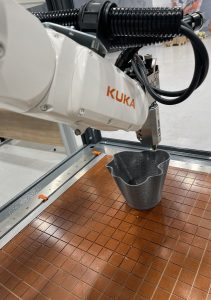 – Reductions in raw material usage: by its very nature, 3D printing utilises less material, compared to subtractive processes – by laying down layers, the process uses the exact amount of material, exactly, with hollow spaces where material is not needed, or adds value to the integrity of the product, thus reductions in product weights are also achieved.
– Reduced energy consumption: the energy supplies required to power large machines do not exist with automated 3D printing. Industrial robots are now being manufactured to operate more efficiently, lighter in weight some industry models are requiring 45% less energy to operate than previous generations. Production can also take place in lights-out scenarios or ‘dark factories’ where lighting or heating is not required – production takes place independent of any human interaction, thus further driving energy efficiencies and reduced usage.
– Improved product integrity, performance and finish:
In addition to increased productivity, 3D printing alleviates any deviations in the quality parameters of items being produced. Any changes to the product or quality improvements can be undertaken quickly. Generative artificial intelligence and machine learning are also coming to the fore, especially so where identical product iterations are being manufactured on mass – failures are not just reducing, but are being addressed before they happen, via application specific software and interfaces.
– Cost to manufacture is falling: This is probably to most pertinent of all afore mentioned advantages. Reduced cost of manufacture = reduced cost of ownership. Any savings that can be achieved within the production process can be passed to the customer. A cheaper, yet higher quality item is going to more desirable, and therefore higher volumes shall be required, driven by demand.
3D printing has opened up an entire new realm of manufacturing capabilities. Markets such as medical are using the process to manufacture metal prosthetic parts, the automotive sector is using additive manufacturing to produce engine covers and brake ducts, even the construction industry is starting to witness the possibilities that 3D printing affords. Currently 3D printed concrete is being utilised within modular house building, as rising material costs brings the construction site indoors, driven by a rise in digital tool adoption.
Complex mould construction is a thing of the past. Large financial expenses are no longer being incurred. If anything, they are beinge liminated by using additive manufacturing (3D printing).”